

Key Takeaway
Indonesia's AI adoption is split by layer. Individuals lead: 69 percent of Indonesian workers used AI for their role in the past year against 54 percent globally, and 33 percent rank as advanced users against 16 percent. Organisations lag: the country scores 27 out of 100 on the 2026 SEA mid-market AI Adoption Index.
In the middle of an ERP scoping call in August, a manufacturing client asked whether we could add AI to their purchase requisition flow. Every person in that room had a chat window open on a second screen. Three questions later — which system holds the supplier list, who owns that list, and is the product master clean enough to match on — the idea was quietly parked, and we went back to discussing report layouts. That twenty minutes is the whole Indonesian AI story in miniature.
This post is about adoption depth, not data centres, not GPU supply and not compliance mechanics. I build and sell ERP software to Indonesian mid-market companies, which means the 26 percent implementation figure in the surveys is not an abstraction to me — it is the room I was sitting in. I have used published survey data for the layers I cannot see directly, and I have marked my own observations as observations.
Two numbers that do not look like they come from the same country
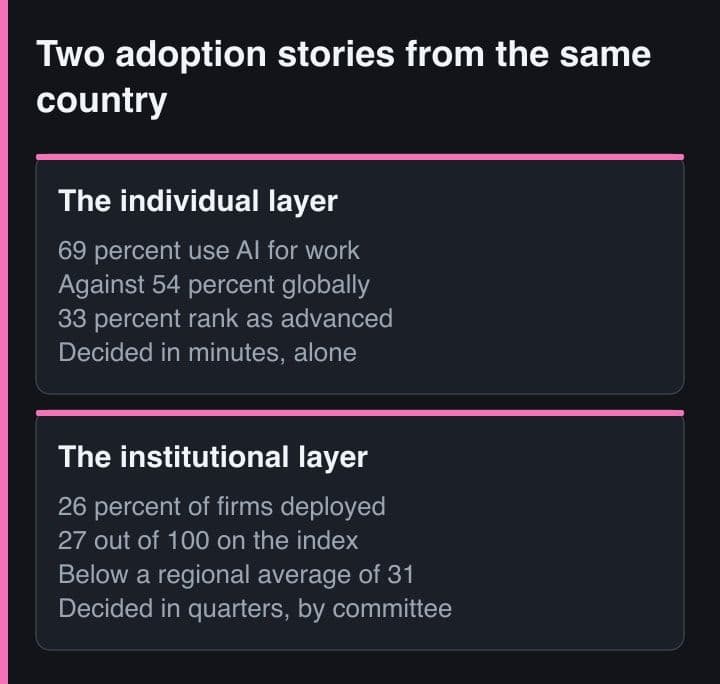
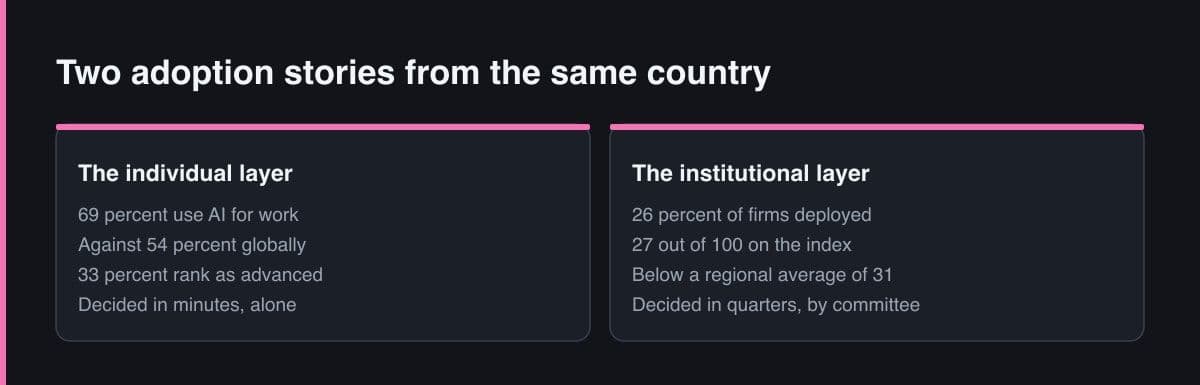
Start with the individual layer. PwC's 2025 Global Workforce Hopes and Fears survey covered 49,843 workers across 48 countries and sectors, including 812 respondents in Indonesia, and found that 69 percent of Indonesian workers had used AI for their role in the past twelve months, against 54 percent globally. Microsoft's Work Trend Index 2026 puts 33 percent of Indonesian workers in its advanced-user category, more than double the global average of 16 percent, and reports 72 percent of Indonesian AI users saying they can now produce work they could not have produced a year ago, against a global 58 percent.
Now the institutional layer. The Pertama Partners SEA mid-market AI Adoption Index 2026 scores Indonesia 27 out of 100 and places it in the Early Experimentation stage, below the regional average of 31 and well below Singapore's 52. Only 26 percent of Indonesian organisations have implemented AI tools. In the same index, 93 percent of Indonesian businesses express confidence in their ability to deploy AI.
Those two paragraphs describe different countries. The honest reading is not that Indonesia is behind on AI. It is that Indonesia is ahead at the layer where adopting costs an evening, and behind at the layer where adopting costs a procurement cycle. Right path, wrong layer.
What 93 percent confident and 26 percent implemented looks like in a meeting
I have never sat opposite an Indonesian client who was against AI. Not once. The confidence figure is entirely believable to me, because confidence in that survey means confidence in the tool, and the tool is genuinely easy. Everyone in the room has used it. Several of them use it every day. When a finance manager says we can definitely do this, they are reporting a true fact about a chat window.
Implementation means something else. It means a model reads company data, which means the company holds data in a shape a model can read, which means somebody has to own that shape. The index says the quiet part itself: those confidence figures represent sentiment rather than demonstrated capability. The distance between 93 and 26 is not a gap in willingness. It is a gap in plumbing and ownership.
The same index finds that only 63 percent of mid-market companies report having a clear AI strategy at all. That segment is where I work. A mid-market Indonesian manufacturer has an ERP, a WhatsApp group, and three spreadsheets the ERP does not know about. It has no AI strategy because there is nobody whose job it would be to have one — IT owns the server, finance owns the process, and the model would have to sit between them.
The five blockers, in the order they actually appear
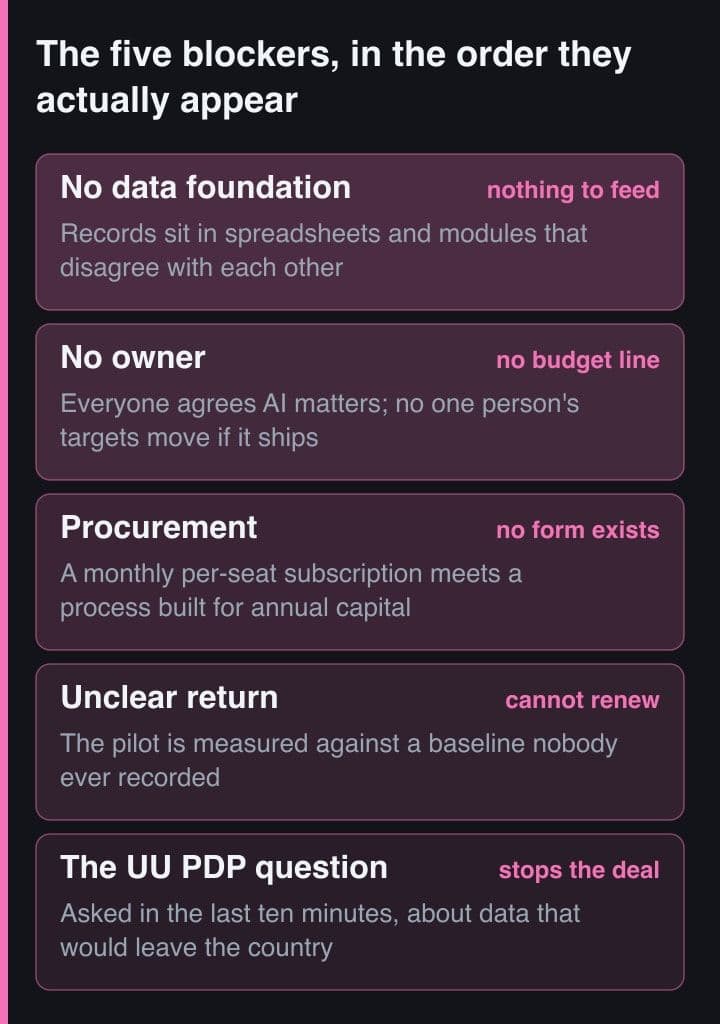
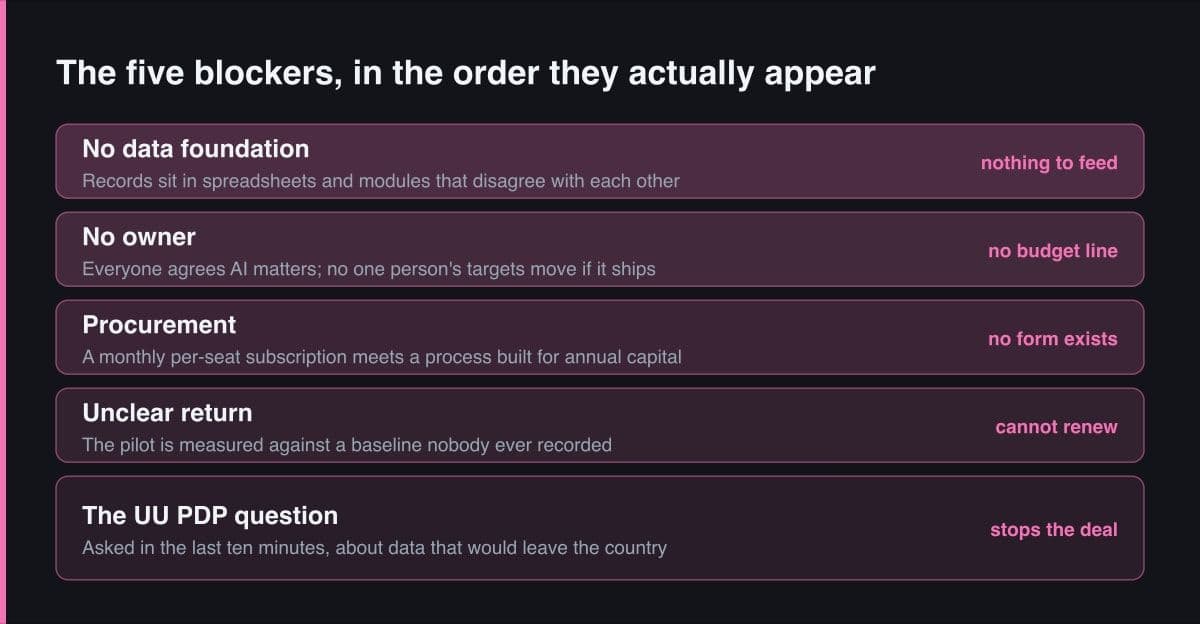
They arrive in a fixed sequence and I have stopped being surprised by it. Each one ends a different fraction of deals, and the later ones are cheaper to fix than the earlier ones, which is the opposite of what most people expect when they walk in.
- No data foundation. The supplier master holds the same vendor four times under four spellings, unit of measure is a free-text field, and the useful history lives in scanned PDFs. Nothing downstream matters until this is fixed, and this is the expensive one.
- No owner. IT owns infrastructure, finance owns the process, and an AI feature belongs to neither. Committees do not ship models. A named person with a budget line does.
- Procurement. AI arrives as a monthly per-seat subscription inside an organisation whose approval flow was built for annual capital purchases. I have watched a small monthly subscription take longer to approve than a piece of factory machinery, purely because only one of the two had a form.
- Unclear ROI. They want the number before the pilot. The pilot is how you get the number. Somebody senior has to be willing to spend one quarter without one, and in a family-owned business that somebody is usually the owner.
- The UU PDP question. It arrives last and it ends the conversation fastest, because the truthful answer today is the personal data law plus your own risk appetite. There is no sectoral AI rule to point at yet.
Blocker one is the only one that is genuinely expensive, and it is also the only one that pays for itself whether or not the AI ever ships. Before I quote an AI feature on top of an existing ERP, I run three queries against the database. They take about a minute and they decide the entire conversation.
-- Three queries I run against a prospect's ERP database before quoting
-- any AI feature. They take a minute and they decide the conversation.

-- 1. How badly duplicated is the master data a model would have to match on?
--    A model cannot reconcile what the humans never reconciled.
SELECT lower(regexp_replace(name, '[^a-z0-9]', '', 'gi')) AS squashed,
       count(*)                                            AS variants,
       string_agg(name, ' | ' ORDER BY id)                  AS spellings
FROM suppliers
GROUP BY 1
HAVING count(*) > 1
ORDER BY variants DESC
LIMIT 20;

-- 2. Is unit of measure a controlled vocabulary, or a free-text field?
--    Past roughly 30 distinct values on a real product master it is free text,
--    and every quantity the model reads becomes untrusted.
SELECT uom, count(*) AS rows
FROM products
GROUP BY uom
ORDER BY rows DESC;

-- 3. How much usable history is there, really?
--    Rows are not history. Rows with a filled-in reason column are history:
--    that column is the only place the WHY of a decision was ever written down.
SELECT date_trunc('month', created_at) AS month,
       count(*)                        AS total_rows,
       count(*) FILTER (
         WHERE reason IS NOT NULL AND btrim(reason) <> ''
       )                               AS rows_with_reason
FROM purchase_requisitions
GROUP BY 1
ORDER BY 1;
If the first query returns twenty rows of duplicate suppliers and the third shows an empty reason column across two years, I say so, and we talk about a data cleanup instead. That is not a lost sale. Deduplicating a supplier master pays for itself in prevented duplicate payments regardless of any model, and it is the only version of AI readiness that survives the pilot being cancelled.
Treat a stated confidence figure as a measure of enthusiasm, not capability — the index itself describes those numbers as sentiment rather than demonstrated capability. If you are scoping an AI feature off how excited the room is, you are scoping off the one signal that costs nothing to produce and predicts nothing about delivery.
The individual layer against the institutional layer, on the same dimensions
Put the two layers side by side on the things that actually decide whether adoption happens, and the pattern stops looking like a national characteristic and starts looking like a cost structure.
| What is being measured | An Indonesian professional | An Indonesian mid-market company |
|---|---|---|
| Stated intent | 85 percent of AI users worry about falling behind if they do not adapt quickly, against 65 percent globally | 93 percent express confidence in their ability to deploy AI |
| Actual use | 69 percent used AI for their role in the past year, against 54 percent globally | 26 percent have implemented an AI tool |
| Depth of use | 33 percent are advanced users, against 16 percent globally | 63 percent report having a clear AI strategy |
| Cost of one attempt | A free tier and an evening | A vendor, a procurement cycle and a data cleanup |
| Who decides | The person doing the work | IT, finance and the process owner jointly, with no single owner |
| Time to a verdict | One prompt. The output is useful or it is not | One quarter at best, usually the next budget year |
| Composite score | Not measured | 27 out of 100, against a regional average of 31 and Singapore's 52 |
Rows one to three and row seven come from the published surveys. Rows four to six are mine — what I see in scoping calls, not a measured figure, and you should read them as one vendor's sample. They are also the rows that explain the others. An individual runs an AI experiment for free and gets a verdict in seconds. A company runs one for a quarter, across three departments, on data nobody has audited. Given those two cost structures, 69 percent and 26 percent are exactly the numbers you would predict.
The loudest message is aimed at the layer that already listened
Raymond Chin has run the RaymondChins YouTube channel since 2015; it now carries 3.47 million subscribers, alongside Sevenpreneur and, from 2021, Ternak Uang. In July he replied on Threads to people accusing him of chasing the AI-influencer trend:
pada takut "Raymond Chin FOMO jadi influencer AI". gw malah takut sama yang blom mau belajar AI... uda masalah survival ini
He is right, and the data agrees with him. I want to be precise about that, because the easy move here is to use a public figure as a foil, and it would be both unfair and factually wrong. Individual AI literacy in Indonesia is a survival issue, and the survey numbers say Indonesians have already treated it as one: 85 percent of Indonesian AI users worry about falling behind against a global 65 percent, and the advanced-user share is double the world average. The message landed.
What interests me is the mismatch in address. The layer that has not moved is not the marketing associate watching business content on YouTube at midnight. It is the finance director who signs the subscription, the IT manager who owns the database, and the family owner who decides whether a data cleanup gets a budget line. I have no audience data for any channel and I am not going to pretend otherwise. What I can say is that in the scoping calls I have sat in, the people who blocked an AI feature were never the people who needed convincing that AI matters. They needed a procurement route and someone accountable for the outcome, and individual literacy supplies neither.
The policy layer is slower than both
Indonesia has had a national AI strategy since 2020. Stranas KA, the Strategi Nasional Kecerdasan Artifisial, runs to 2045 and names five priority sectors: health services, bureaucratic reform, education and research, food security, and mobility with smart cities. As a statement of direction it is now six years old, and it reads as a direction rather than an instrument.
The operational instruments are still unsigned. Two Presidential Regulations were made priorities for 2026, one for the national AI roadmap and one for AI ethics and security. Komdigi's own legal-documentation portal records the roadmap covering 2026 to 2029, convened under Keputusan Presiden 38 of 2025 and targeted for the first quarter of 2026. On 4 September 2026 the Director General of Digital Ecosystem was quoted saying only the President's signature remained. Once signed, each ministry issues its own sectoral rules, with Komdigi acting as cross-sector orchestrator.
For a vendor this is not an abstraction, it is the answer I have to give in the last ten minutes of a scoping call. Asked which rule governs an AI feature that reads employee or customer records, the truthful answer today is the personal data law and your own risk appetite, because there is no sectoral AI regulation yet to cite. A legal department that hears your own risk appetite does not approve; it waits. The absence of a rule is not neutral for adoption. It is a blocker with nobody to escalate to.
If a client is waiting on regulatory clarity, scope the first deployment so it never touches personal data at all. Retrieval over the company's own product documents, contracts and standard operating procedures needs no lawful-basis argument about individuals, and it still teaches the organisation how to run a model in production — which is the actual skill they are missing.
What would actually move 26 percent
Not exhortation. The individual layer already got that message; repeating it at organisations does nothing, because an organisation does not experience the feeling of falling behind. It experiences a budget cycle. Five changes that, in my experience, separate a pilot that ships from one that quietly stops being mentioned:
- Make the first deployment read-only. Retrieval and summarisation over documents the company already trusts, not an agent that writes into the ERP. A wrong answer costs a re-read, not a reversed journal entry, and that difference is what legal is actually deciding on.
- Give it a name, not a committee. One person, one budget line, one process. The strongest single predictor I have for a pilot surviving is whether I know who to call when it breaks.
- Ship the data cleanup as its own project with its own return. Deduplicating the supplier master and constraining unit of measure pay for themselves in fewer duplicate payments and fewer stock errors. Do them because they are worth doing; the AI feature then becomes cheap instead of blocked.
- Buy AI inside software the company already licenses. Procurement is the real bottleneck, and adding a module to an existing contract is a different form from onboarding a new vendor. This is unglamorous, and it is the largest lever I have found.
- Pick a process with a countable unit. Invoices matched per day, requisitions approved per week, tickets closed per person. The pilot has to produce a number on its own, or the next budget conversation has nothing to stand on.
None of these are about models, and that is the point. The Indonesian institutional layer is not primarily blocked on model quality or on talent. It is blocked on four ordinary organisational problems that any new operational system hits, plus one regulatory unknown. Those are solvable with boring tools, and boring tools are the ones nobody makes videos about. Here is the shape of the first deployment I now propose by default:
-- The first deployment that actually survives procurement: read-only
-- retrieval over documents the company already owns. No personal data,
-- so no lawful-basis argument, and no write path into the ERP.

CREATE EXTENSION IF NOT EXISTS vector;

CREATE TABLE doc_chunk (
  id          bigserial PRIMARY KEY,
  doc_id      text        NOT NULL,   -- SOP-QC-014, contract no, spec sheet
  doc_title   text        NOT NULL,
  page_no     int,                    -- so the answer can cite a page
  body        text        NOT NULL,
  embedding   vector(1024) NOT NULL,  -- match the model you actually deployed
  indexed_at  timestamptz NOT NULL DEFAULT now()
);

-- IVFFlat needs data before it is built; building on an empty table gives
-- you an index that never gets used and a pilot that "feels slow".
CREATE INDEX ON doc_chunk USING ivfflat (embedding vector_cosine_ops)
  WITH (lists = 100);

-- Retrieval returns the citation with the text. If the pilot cannot show
-- the operator WHICH page it came from, nobody in QA will trust the answer,
-- and untrusted output is how a pilot dies without anyone cancelling it.
SELECT doc_id, doc_title, page_no, body,
       1 - (embedding <=> $1) AS similarity
FROM doc_chunk
ORDER BY embedding <=> $1
LIMIT 8;
So, is Indonesia on the right path? At the layer that can move without permission, yes, and the evidence is strong: more workers using AI than the global average, twice the share of advanced users, and a well-founded fear of being left behind. At the layer that needs a budget, an owner and a rule, not yet. If you build software for Indonesian companies, stop selling the idea of AI — it is already sold — and start selling the procurement route, the data cleanup and the named person. That is the layer where the number actually moves.
Sources and further reading
- Pertama Partners — Indonesia's AI opportunity across 65 million MSMEs, citing the SEA mid-market AI Adoption Index 2026
- Microsoft Source Asia — Work Trend Index 2026: 33 percent of Indonesian workers at the forefront of AI adoption
- PwC Indonesia — Global Workforce Hopes and Fears Survey 2025, Indonesia findings
- KORIKA — Strategi Nasional Kecerdasan Artifisial Indonesia 2020 to 2045 (PDF)
- JDIH Komdigi — inter-ministerial discussion of the national AI roadmap Presidential Regulation
- Selular.id — the two AI Presidential Regulations awaiting the President's signature, 4 September 2026
- Raymond Chin on Threads, 18 July 2026 — the quoted post
- Wikipedia Indonesia — Raymond Chin, channel and company background