

Key Takeaway
Indonesia's sovereign AI data centres change two things for a developer in 2026: a data-residency answer you can put in a contract, and a shorter network hop. They do not change where model weights, package registries or the cloud control plane live, and a 360 MW campus contracted for 2028 rents nothing today.
Every ERP deal I have worked on in Indonesia eventually produces the same question from the client's side of the table: does our data stay in the country. For years the honest answer was a hedge about Singapore being one short hop away, and it usually held. Then the announcements started, and the question changed shape. Now people ask whether the AI features can sit in a sovereign data centre too, and they expect a yes.
So I read the announcements instead of the headlines about them. BDx Indonesia's sovereign AI campus, the Tencent Cloud facility in GoTo's press release, Microsoft's four-year commitment and CoreWeave's 360 megawatts. Two things genuinely change for a team shipping this quarter. Three things everyone assumes change do not. This post is that split, plus the reading skill that separates them.
Sovereign is a claim about jurisdiction, not about silicon
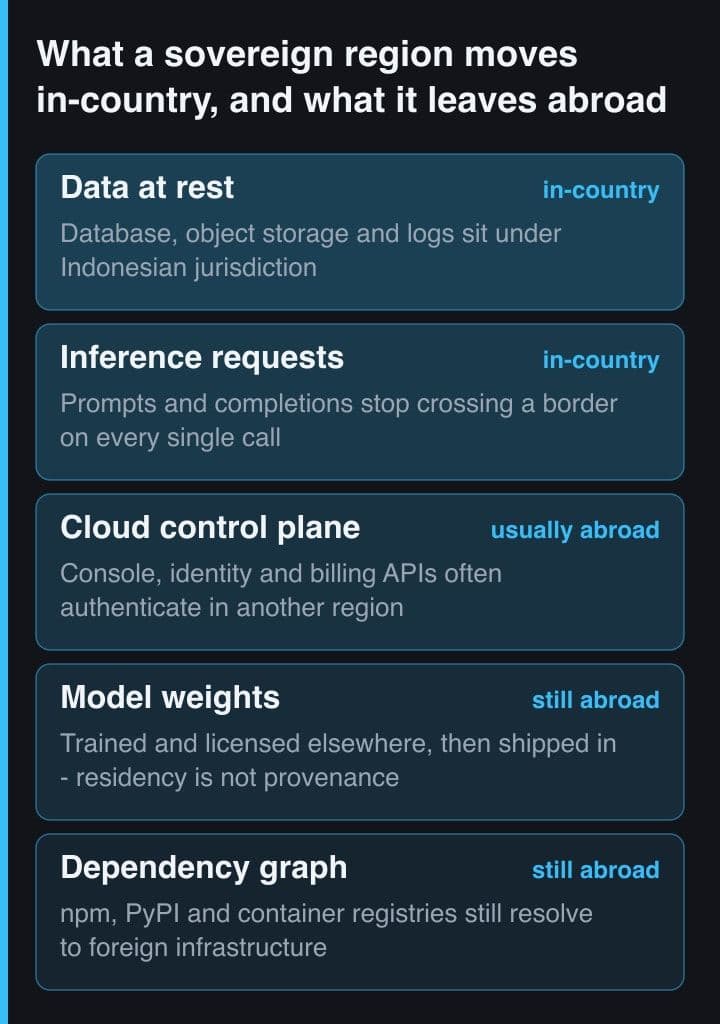
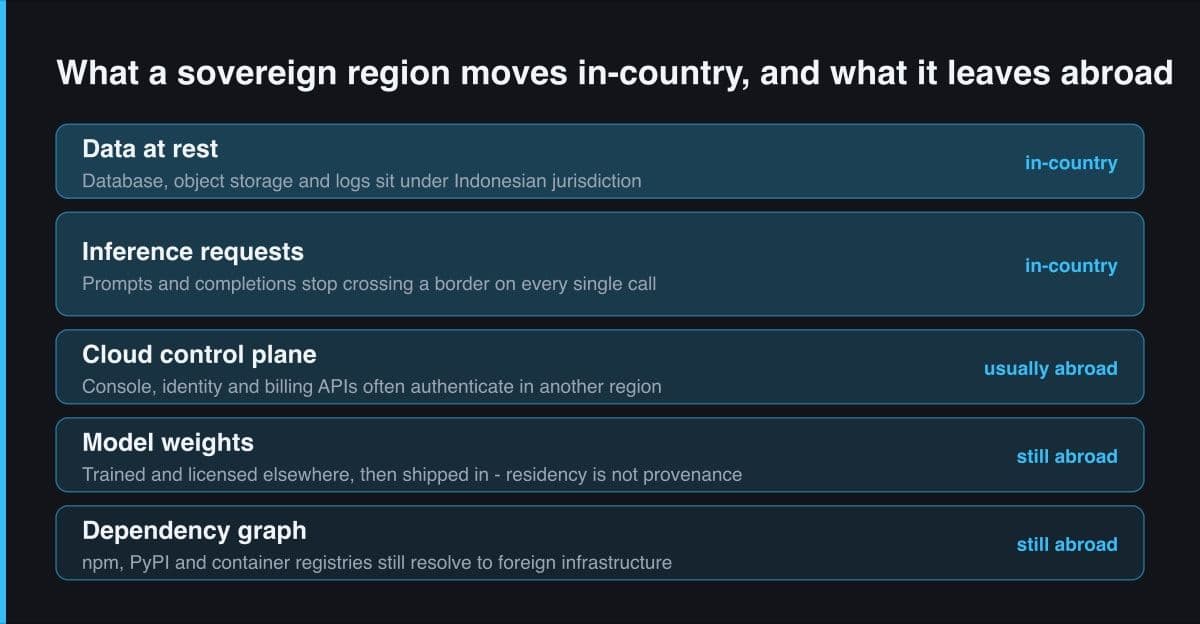
Read the announcements side by side and the word settles into a much narrower meaning than it carries in conversation. GoTo's release on its Tencent Cloud agreement says the arrangement will ensure GoTo's data remains onshore in Indonesia, directly supporting data sovereignty and enhancing data security for Indonesian users and businesses. BDx describes its December 2024 launch as part of creating Indonesia's sovereign AI cloud. In both cases the claim is about where bytes physically sit and whose courts can compel access to them. That is a real and useful claim. It is also the entire claim.
- It does not say who designed or owns the accelerators. BDx built its campus on NVIDIA's accelerated computing platform, which is foreign hardware in an Indonesian building.
- It does not say where the control plane runs. The console, the identity provider and the billing API can sit in another region while your data does not.
- It does not say where the model came from. A model trained abroad and served from Jakarta is a residency fact, not a provenance one.
- It does not say the operator is Indonesian. CoreWeave states plainly that it will own and operate the compute environment across all three of its Indonesian sites.
None of that makes the term dishonest, and none of it is hidden. It makes the term narrow. Sovereignty as these operators use it is a statement about location and jurisdiction, and the moment you stretch it to mean independence, you have started selling something nobody promised.
What genuinely changes: a residency answer you can put in writing
The first real change is contractual rather than technical. Before in-country AI capacity existed, an Indonesian team facing a regulated customer had three options: host in Singapore and argue the transfer was lawful, run inference on the customer's own hardware, or take the AI feature out of the deal. All three cost something. The first one cost negotiating time on every single renewal, which is the kind of cost that never appears in an architecture diagram.
There is now a fourth option, and its value is that it removes an argument rather than winning one. The reason GoTo gives for the Tencent arrangement is exactly that: keeping data onshore in support of data sovereignty. If your customer's compliance team has a residency requirement written down somewhere, a sovereign region converts a recurring debate into a line item. That is worth real money and real calendar time, and it is the part of this story I would not talk anybody out of.
The latency win is real, and smaller than the press release implies
The second change is physics. A request that used to leave the country and come back now stays inside it, and the milliseconds you recover are the ones no amount of code could ever have optimised away, because they were set by the speed of light in fibre and the number of round trips in a TLS handshake. That part is not arguable. What is very arguable is how large a share of a user-visible AI request those round trips were, and the only way to know is to measure your own endpoint rather than reason about it.
// Where an LLM request actually spends its time. Measure your own endpoint:
// the only term an in-country region shortens is the network round trip
// hiding inside time-to-first-token.
const started = performance.now();
const res = await fetch(endpoint, { method: "POST", headers, body });

let firstTokenAt = 0;
let outputTokens = 0;

for await (const chunk of res.body) {
  // The first byte of the stream is RTT + queue + prefill, all three at once.
  if (!firstTokenAt) firstTokenAt = performance.now();
  outputTokens += countSseTokens(chunk);
}
const finished = performance.now();

console.log({
  ttftMs: Math.round(firstTokenAt - started),
  decodeMs: Math.round(finished - firstTokenAt), // geography does nothing here
  outputTokens,
});

// Compare the two numbers before you move anything. If decodeMs dwarfs ttftMs,
// a shorter network hop is buying you a percentage you cannot feel.
Run that against the model you actually serve and the shape of the answer is usually the same. Time to first token contains the network hop, the queue and the prefill, all bundled together. Everything after it is decoding, and decoding is indifferent to geography. Moving a region in-country shortens one term in a sum whose largest term is normally the number of output tokens you asked for. It is a genuine improvement to how a chat interface feels and a rounding error on a nightly batch summarisation job. Decide which one you are building before you pay to move it.
What sovereignty does not fix
A sovereign region moves your data. It does not move your supply chain. The weights you serve were almost certainly trained somewhere else, and the container serving them was built from packages that resolved to registries on another continent. If the worry underneath your customer's residency clause is really dependency risk rather than data location, an in-country region addresses none of it, and it is worth finding that out before rather than after the migration.
# A sovereign region says nothing about where your build pulls from.
# Ask each toolchain which host it will actually contact:
npm config get registry           # https://registry.npmjs.org/
pip config get global.index-url   # https://pypi.org/simple
go env GOPROXY                    # https://proxy.golang.org,direct

# Then resolve those hosts from INSIDE the sovereign VPC, not from your laptop.
# A build runner in a new region often gets different answers to both lines.
dig +short registry.npmjs.org
curl -s -o /dev/null \
  -w "connect=%{time_connect}s  ip=%{remote_ip}\n" \
  https://registry.npmjs.org/

# If the answer matters to your compliance story, mirror the registry in-region.
# Moving the database and leaving the supply chain abroad fixes one of two things.
The reason to run those commands from inside the sovereign VPC rather than from your laptop is that the answers differ. A build that resolves to a nearby edge and a build that reaches a distant origin look identical in the log until one of them is slow or unreachable. None of this is an argument against moving in-country. It is an argument against telling a customer that moving solved a problem it never touched.
When a vendor calls a region sovereign, ask one follow-up question: which of my data planes does that cover, and where does the control plane authenticate. The answer takes about a minute to give and it separates an operator who has thought the model through from a marketing page that has not.
The money is real. The calendar is the problem
None of this is vapour. Microsoft announced USD 1.7 billion for Indonesian cloud and AI infrastructure on 30 April 2024, spread across four years. The Tencent Cloud facility in GoTo's November 2024 release is described as a third Indonesian data centre inside a commitment of around USD 500 million by 2030. CoreWeave announced three Indonesian facilities in August 2026 totalling 360 megawatts of contracted IT power. These are large numbers from companies that do not announce buildings they have no intention of putting up.
Read the dates rather than the totals, though, and every one of them is a multi-year figure with most of its weight at the far end. Mordor Intelligence sizes the Indonesian data centre processor market at USD 4.88 billion in 2025 and USD 6.29 billion in 2026, reaching USD 22.39 billion by 2031 at a compound rate of 28.9 percent. That is a research estimate rather than a measurement, and the shape is the useful part: most of the curve sits after 2028. A product shipping this quarter lives entirely in the flat section at the left.
Announced megawatts are not rentable capacity
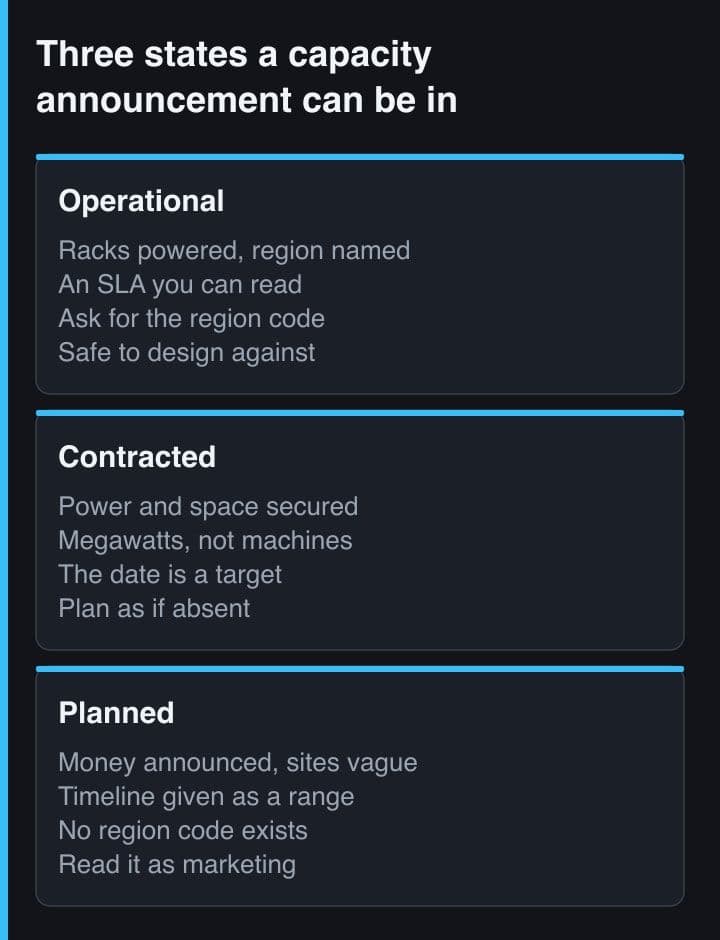
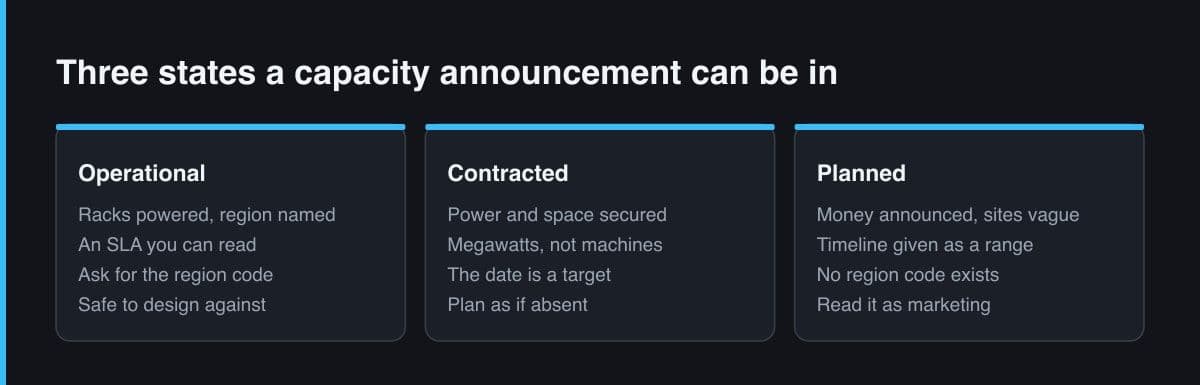
This is the reading skill worth taking away from the whole subject. Every capacity announcement sits in one of three states, and the press release almost never says which one. Contracted IT power means an operator has secured power and space under an agreement, not that a machine exists to log into. CoreWeave's 360 megawatts are contracted and expected online in 2028, which is a serious commitment and a completely useless one for anything you are building now.
| Announcement | State it is in | What it does for a product shipping this quarter |
|---|---|---|
| BDx Indonesia, CGK4 AI campus phase 1, launched 4 December 2024 | In service | The only entry here that existed before you read this sentence. Access is through the operator, so budget for a conversation rather than a signup form |
| Tencent Cloud, a third Indonesian data centre, around USD 500 million by 2030 | Announced, spend running to 2030 | The word third implies two already in service, so onshore hosting predates the announcement. The rest of the money buys capacity you cannot schedule against |
| Microsoft, USD 1.7 billion announced 30 April 2024 over four years | Phased across a four-year window | Infrastructure and skilling land across the window rather than on one date, so check what is available now instead of what was announced |
| CoreWeave, three sites, 360 MW of contracted IT power, announced August 2026 | Contracted, expected online in 2028 | Nothing. Write the plan that works without it, and treat the 2028 capacity as upside rather than as a dependency |
The BDx line is the one that carries the argument, because it is the only row already in service. The joint venture of Indosat Ooredoo Hutchison, Lintasarta and BDx Data Centers launched what it called Indonesia's first sovereign AI data centre on 4 December 2024, as phase one of the renewable-powered CGK4 campus. Everything else on that list is a commitment with a date attached, and dates in this industry move in one direction.
A sovereign region with a single availability zone is a downgrade in availability sold as an upgrade in compliance. Before moving a production workload in-country, ask how many independent zones exist and where failover goes when there is only one. Trading a multi-zone foreign region for a single-site domestic one is a real engineering decision, not a formality, and it deserves a name against it.
When in-country hosting is the right call, and when it is a story
Here is the test I now apply, in this order. It takes about ten minutes and it has stopped me twice, which is the only reason I trust it.
- Is there a named requirement. A clause in a contract, a regulator's questionnaire, a line in a customer's security review — something you can point at. If the requirement is a feeling that local is safer, stop at step one.
- Does it cover the data you are actually moving. Residency rules usually name personal or financial data, not build artefacts, metrics or logs. Move what is covered and leave the rest where it already runs well.
- Can you boot an instance this quarter. If the capacity you are counting on has a year attached to it rather than a region code, it is not part of this plan. Write the plan that works without it.
- What does the availability story look like afterwards. If the honest answer is worse than today, the compliance win has to be worth the reliability loss, and somebody senior should agree to that trade in writing.
Three of those four are questions about your own project rather than about Indonesian infrastructure, which is the honest summary of this entire subject. The capacity is arriving, and it is arriving faster than most local teams expect. Whether it changes what you ship this quarter depends almost entirely on whether a specific person is asking you a specific question you currently cannot answer.
Sovereign AI capacity in Indonesia is neither hype nor a step change. It is a new option that removes one argument from a sales cycle and a few milliseconds from a request, while leaving model provenance, the dependency graph and your availability posture exactly where they were. Treat sovereign as a jurisdiction claim, read every capacity announcement for which of the three states it is in, and make the move when a named requirement forces it rather than when a press release suggests it.
Sources
- BDx Data Centers — Indonesia's first sovereign AI data centre, built with NVIDIA accelerated computing, 4 December 2024
- GoTo Group — press release on the Tencent Cloud and Alibaba Cloud agreements, including the third Indonesian data centre and the USD 500 million commitment
- CoreWeave — expanding its AI cloud platform into Indonesia: three sites, 360 MW of contracted IT power, expected online in 2028
- Microsoft — USD 1.7 billion investment to advance Indonesia's cloud and AI ambitions, 30 April 2024
- Mordor Intelligence — Indonesia data centre processor market size, share and growth forecast to 2031