

Key Takeaway
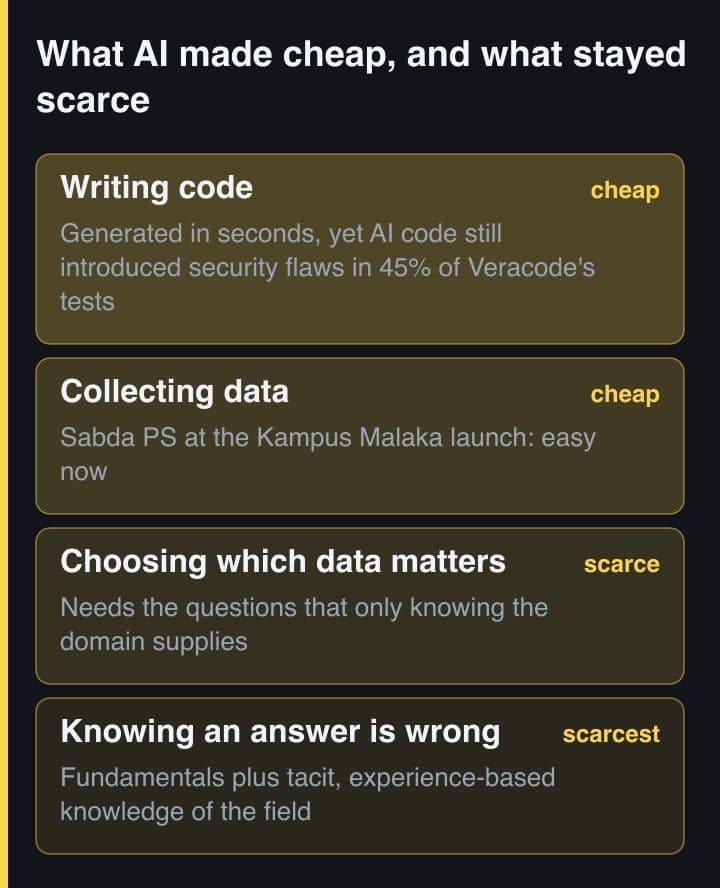
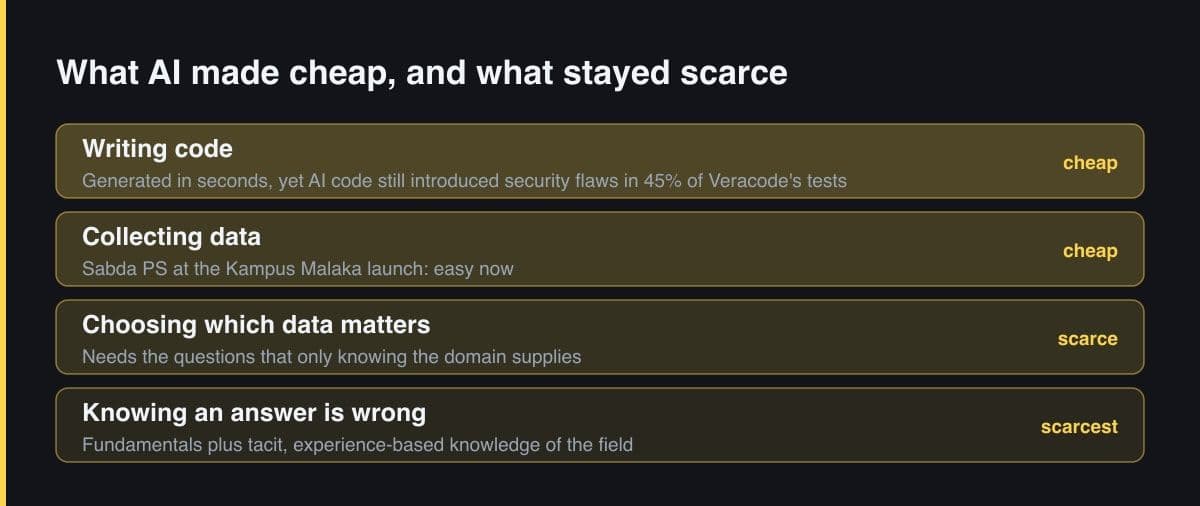
In the AI era, domain knowledge is worth more than prompting skill. Writing code and collecting data are now cheap; knowing which data matters and when an answer is wrong is not. Sabda PS made this case at the Kampus Malaka launch, and Stanford payroll research points the same way: AI substitutes codified knowledge and complements experience.
On 20 October 2026, at Citywalk Sudirman in Jakarta, Malaka launched Kampus Malaka: a new campus for SMA, SMK and madrasah graduates with a single study programme, data science. In the Q&A, Ferry Irwandi pushed back on a popular idea. People always say the AI era belongs to whoever prompts best, he said, and that is wrong. Sabda PS, the Zenius co-founder behind the curriculum, then explained why with his own coding: prompting well is not easy, because you have to know how the database and the modules are structured, or the code tangles the moment you change it. [3, 1]
That matched what I see in ERP work, so I went further than the clips. I read the auto-generated transcripts of both talks end to end, checked the claims around them against a dozen sources, including Stanford payroll research, a field experiment with 758 BCG consultants and Drew Conway's original data science diagram, and added what domain knowledge looks like in systems I have built. I have no affiliation with Malaka. This is an engineer's reading of an education argument.
What Sabda PS actually said at the Kampus Malaka launch
The two videos went up on Malaka's YouTube channel in late October 2026 and are worth watching in full, but the argument fits in five claims. I have kept the timestamps so you can check each one. The quotes are my translations from Indonesian, lightly cleaned from the auto-generated transcript. [1, 2]
| Claim | Video | Time |
|---|---|---|
| Prompting well is hard: you have to know the database and the module structure, or the code tangles when you change it | Jurusan Paling Dibutuhin di Era AI | 4:05 |
| Data science is not just coding and statistics; it needs domain expertise, chosen by each student | Jurusan Paling Dibutuhin di Era AI | 6:12 |
| Because AI exists, data science has become very easy, yet data science is not only about coding | Kuliah Bukan Cuma Soal Gelar dan Pekerjaan | 20:04 |
| Collecting data is easy now; knowing which data matters, turning it into insight and automating it is different | Kuliah Bukan Cuma Soal Gelar dan Pekerjaan | 22:14 |
| The curriculum: a Madilog foundation, data science as universal tooling, then electives to choose an industry | Kuliah Bukan Cuma Soal Gelar dan Pekerjaan | 23:47 |
He also explained why the campus picked data science at all. Indonesian regulation only allows certain programme names, and among them he wanted what he called a platformic programme: one that, like philosophy or management, works across industries instead of feeding one. Data science, in his words, is the Microsoft Excel or Google Sheets of the 21st century, a tool you can carry into agriculture, aquaculture, manufacturing, media or education. [2]
His motive is the part most summaries skip. He worries that the AI era becomes more unequal, with a widening gap between the people whose work is replaced and the people who own the machines. His answer is to train students to sit in the middle, as creators and operators of automation, and that requires knowing both the tool and the domain it automates. [2]
Prompting is now the cheap part
Sabda's coding example has numbers behind it. Veracode tested code from over 100 large language models in Java, JavaScript, Python and C#, and found that AI-generated code introduced risky security flaws in 45% of tests. Larger, newer models did not improve security. A model writes what you ask for; it does not know which rule of your system it just broke. [6]
The clearest field experiment is older, and still the best. In 2023, 758 Boston Consulting Group consultants were randomly given GPT-4 or not. On tasks inside what the researchers called the jagged technological frontier, consultants with AI finished 12.2% more tasks, 25.1% faster, at 40% higher quality. On a task just outside it, consultants without AI got the answer right 84% of the time; with AI, only 60 to 70%. The AI sounded equally confident both times. Knowing which side of the frontier a task sits on is not a prompting skill. It is domain knowledge. [7]
The expensive mistake
It is rarely a bad prompt. It is a fluent answer to the wrong question, accepted by someone who did not know enough about the domain to doubt it.
Stanford's payroll data: AI replaces textbook knowledge first
The strongest evidence comes from employment records. Erik Brynjolfsson, Bharat Chandar and Ruyu Chen follow millions of US workers through ADP payroll data. In their August 2026 revision, employment of workers aged 22 to 25 in AI-exposed occupations stands 19% below where it would be had it kept pace with less-exposed peers, while experienced workers show no comparable gap. The declines concentrate where AI substitutes for human tasks; where it complements workers, employment is flat or rising. [8]
Their explanation is the domain knowledge argument in economists' language. AI more effectively substitutes for knowledge that has been digitised and codified, the core of formal education, while complementing the tacit, experience-based knowledge held by senior employees. Occupations that rely on tacit knowledge saw faster employment growth for experienced workers. The authors call these early, descriptive indicators rather than causal estimates, and that caveat matters, but the direction has held for a year of updates. [8]
The philosopher Michael Polanyi named the underlying problem in 1966: we can know more than we can tell. What nobody writes down cannot go into a training set or a prompt. A second study shows the other side of the coin. When a generative AI assistant was given to 5,179 customer support agents, productivity rose 14% on average and 34% for novice and low-skilled workers, with minimal impact on experienced ones. The researchers found suggestive evidence that the model was spreading the best practices of the most able workers. The AI packaged the experts' domain knowledge and handed it to novices. The experts were the source. [9, 10]
Data science was always three circles, not one
Sabda's point that data science is not just coding and statistics is not new, which is a point in its favour. In 2010 Drew Conway drew the Data Science Venn Diagram with three circles: hacking skills, maths and statistics knowledge, and substantive expertise. Science, he wrote, requires motivating questions about the world, and those come from knowing the field. [11, 1]
His most quoted warning is about hacking skills plus substantive expertise without the maths: the danger zone, where people know enough to be dangerous. AI makes that zone bigger, because it hands everyone the hacking circle. The Kampus Malaka design reads to me as an attempt to fill all three circles in a deliberate order. [11]
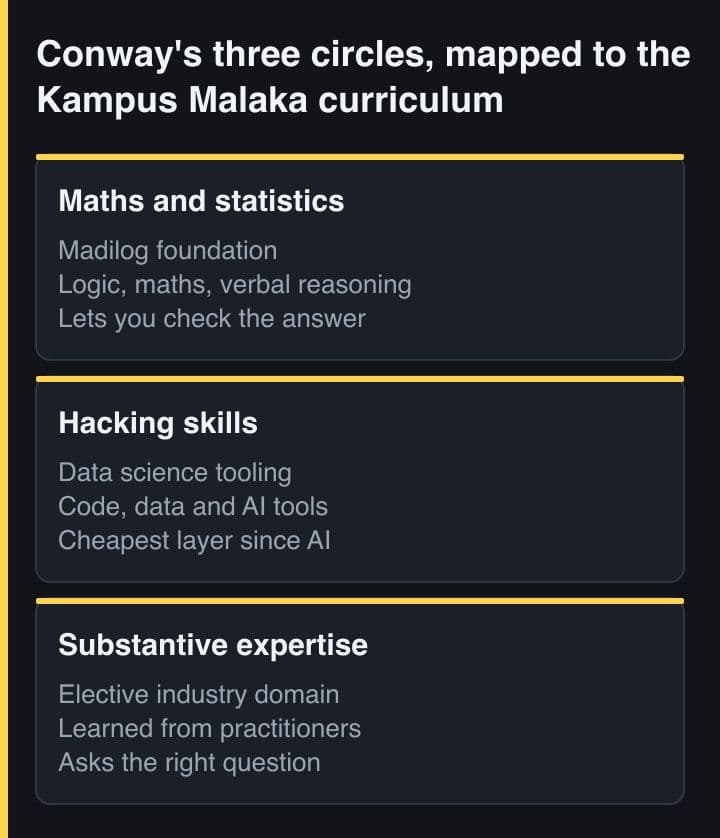
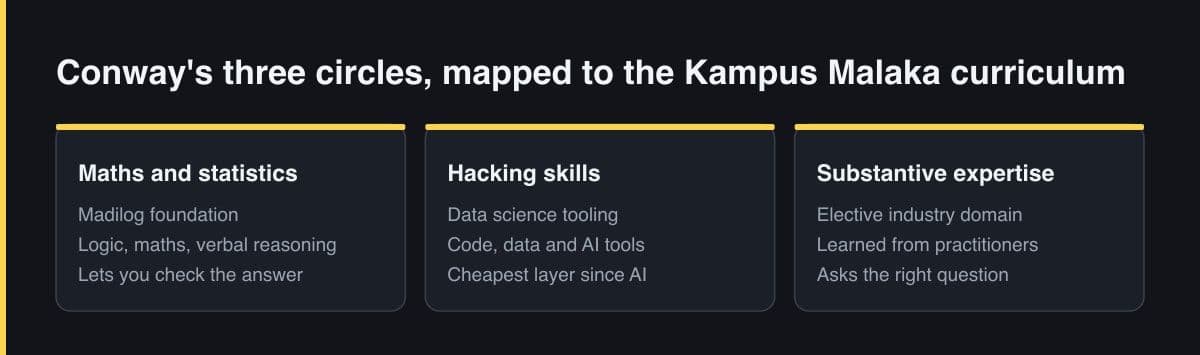
Sabda's own example shows the third circle at work. He described hundreds of millions of data points from Indonesian students working through maths problems at Zenius, and said that with them he knows exactly where a student's understanding has a hole and where to intervene. No model trained on generic data knows that. It took years inside one domain to know which question to ask of the data. [1]
Madilog: the foundation layer under the tools
The foundation Sabda chose is Madilog, the book Tan Malaka wrote in Batavia in 1942 and 1943, short for materialism, dialectics and logic. He maps it onto three plainer goals. Logic covers mathematical thinking, verbal reasoning and thinking skills. Materialism is about reliable knowledge, or as he put it: how do you know what you know is true? Dialectics, for him, means history, evolution and anthropology: how people change in their struggle with nature and with each other. [5, 2]

He defended that foundation with a football analogy. A degree that trains one narrow skill is like a right back who can only tackle and run: not agile, not adaptive, and if one day AI has the tool, you are replaced. He traced Indonesia's narrow majors to colonial-era schools built to produce specific workers, such as STOVIA, the medical school that became today's FKUI. [2]
I would put it in engineering terms. Fundamentals are what let you check the machine. Without logic and some statistics you cannot tell a plausible regression from a correct one, and without a habit of asking how you know something is true, you will believe the most fluent answer. Domain knowledge tells you what to ask. Fundamentals tell you whether the answer holds.
What domain knowledge looks like in my ERP work
I build ERP systems, and the most valuable facts in them never came from code. When I built the accounts payable module of ANCoraPRO for a client, the approval chain was submitted, manager, finance, approved, payment, paid. There was no CFO step. A generic approval template could easily include an executive sign-off; this company's process did not, and software that added one would look professional and still be wrong. The ANCoraPRO case study has the full before and after.
Qilap, the carwash ERP I build and run, is the same story. It splits the work between a mobile field app for the crew and a POS for the admin, and it lets one wash be paid with more than one method. None of that came from a prompt. It came from how a carwash actually operates: who holds the phone, who holds the cash drawer, and how customers really pay.
My own job title, AI Forward Deployed Engineer, is a bet on the same idea. The models are the same for every company. What differs is how well they are wired into one company's real systems, rules and exceptions, and that takes someone who learns the domain, not someone who only learns the model.
If you are choosing a jurusan or a career in Indonesia
Employers say something similar in their own surveys. The World Economic Forum's Future of Jobs Report 2025 found that analytical thinking is the top core skill, with seven in ten companies calling it essential, that AI and big data are the fastest-growing skills, and that employers expect 39% of workers' core skills to change by 2030. The tool layer changes fastest. The thinking layer and the domain layer are the ones that carry over. [12]
| Layer | What to learn | Sign it is working |
|---|---|---|
| Foundation | Logic, maths, statistics, clear writing | You can explain why an answer is wrong, not only that it looks wrong |
| Tooling | Data skills, programming, AI tools | You automate a task end to end, then check every output |
| Domain | One industry, learned from the people who run it | You know which data matters before you open the dataset |
Kampus Malaka is one way to build those three layers, and I find its design coherent. It is also brand new, launched two weeks before I wrote this, so its outcomes are unknown. The same layers can be built through any degree, a job inside an industry, or a side project you care about. What matters is that the domain layer is real: learned from the people who do the work, not from summaries of it.
Kampus Malaka at a glance, as reported on 2 November 2026 [3, 2, 4]
- Launched on 20 October 2026 at Citywalk Sudirman, Jakarta, at Malaka's third anniversary
- One programme, data science, on a Madilog foundation, with electives to choose an industry domain
- Curriculum initiated by Sabda PS (Sabda Putra Subekti), who co-founded Zenius in 2004
- Open to SMA, SMK and madrasah graduates of any age without a selection test, according to Sabda PS
- Ferry Irwandi said the fee will not exceed Rp2,900,000, as reported by IDN Times; check Malaka's official channels for current terms
Where I would add a caveat
Domain knowledge is not automatically safe. The customer support study shows that codified expertise can be packaged and spread by AI, so the scarce part is the tacit layer: the exceptions, the judgement of when a rule should bend, and the trust of the people who run the operation. Knowing the textbook version of a domain is a weaker advantage every year. [10]
Fundamentals are not optional either. Conway's danger zone is exactly what a domain expert with AI tools and no statistics looks like: confident analysis that nobody can check. That is why I read Sabda's order, foundation first, then tools, then domain, as the most important part of his argument rather than a detail of one curriculum. [11]
Prompting is a skill the way typing is a skill: worth learning, and quickly commoditised. Use AI for the parts that are now cheap, the typing, the collecting and the formatting, and spend the time it saves going deeper into one domain. A prompt is only as good as what you know about the problem.
Your turn
What do you know about your field that no AI model could have told you? Send me one example. The best ones are always boring and specific: an exception, a workaround, a rule that exists only because of one bad day.
Reply through the contact page or on LinkedIn
This post answers the question I left open in People, process, technology in the AI era: still valid?
Related reading
- People, process, technology in the AI era: still valid?
- ERP process mapping: the requirements work that saves projects
- Domain-driven design: bounded contexts explained
Sources
- MALAKA on YouTube: Jurusan Paling Dibutuhin di Era AI Ternyata Ini (29 October 2026)
- MALAKA on YouTube: Kuliah Bukan Cuma Soal Gelar dan Pekerjaan (23 October 2026)
- IDN Times: 3 Tahun Malaka, Resmikan Kampus buat Lulusan SMA dan Sederajat (21 October 2026)
- Wikipedia (Indonesian): Zenius Education
- Wikipedia: Madilog
- Veracode, 2025 GenAI Code Security Report
- Ethan Mollick, Centaurs and cyborgs on the jagged frontier (16 September 2023)
- Brynjolfsson, Chandar and Chen, Canaries in the Coal Mine? Stanford Digital Economy Lab (revised August 2026)
- Wikipedia: Polanyi's paradox
- Brynjolfsson, Li and Raymond, Generative AI at Work (NBER Working Paper 31161)
- Drew Conway, The Data Science Venn Diagram (30 September 2010)
- World Economic Forum, The Future of Jobs Report 2025