

Key Takeaway
Bootcamp and self-taught routes into Indonesian software work differ less in curriculum than in structure, feedback and cohort. A sixteen-week bootcamp can list a fee near Rp45 million while a self-study subscription lists Rp1.5 million a month. AI tooling made curriculum delivery cheap, so choose on accountability, on the evidence produced, and on whether you finish something real.
On the day I checked, Hacktiv8's AI-Enhanced Full Stack Developer Bootcamp listed Rp45,000,000 for sixteen weeks, full-time Monday to Friday, with batch 102 starting on 21 September 2026. In another tab, Dicoding's help centre listed Rp1,500,000 for a thirty-day subscription and Rp12,600,000 for a year. Those two numbers are how nearly everyone frames this decision, and framing it that way is the mistake.
I took neither route. I did a degree at Swiss German University and worked part-time at an ERP company while I did it, which means I have mostly watched these two routes from the side that eventually reads the code. This post compares them on the axes that genuinely differ in 2026 — structure, feedback, evidence and network — using published fees and the 2025 Stack Overflow Developer Survey, and it treats every advertised outcome statistic as unverified, because none of them are audited by anyone you can name.
The two prices, and the cost neither page prints
The fees themselves are public and easy to compare. Hacktiv8's immersive lists Rp45,000,000, with an early-bird rate of Rp43,000,000 on the same page. Dicoding's help centre lists Rp1,500,000 for thirty days, Rp4,500,000 for ninety days and Rp12,600,000 for a year. The Odin Project's full-stack path costs nothing at all. If money were the whole question there would be no post to write.
// The two fees are easy to compare. The two schedules are not.
// Hacktiv8 lists the immersive as 16 weeks, Mon-Fri, 09:00-18:00 WIB.
const bootcampHours = 16 * 5 * 8; // ~640 scheduled hours, breaks removed

// A self-taught week that survives a weekday job looks more like this.
const eveningsPerWeek = 4;
const hoursPerEvening = 2;
const weekendHours = 4;
const selfTaughtWeek = eveningsPerWeek * hoursPerEvening + weekendHours; // 12

const weeksToMatch = Math.ceil(bootcampHours / selfTaughtWeek); // 54

// So the honest unit is not rupiah per course. It is months of elapsed
// life -- and the bootcamp buys those months by taking every working
// hour of your weekday, which is the cost no fee page prints.
What no fee page prints is the schedule. Hacktiv8 states the format on its own page: full-time, Monday to Friday, 09:00 to 18:00 WIB. Sixteen weeks of that is roughly 640 scheduled hours, and you cannot hold a weekday job through it. Twelve honest hours a week — four evenings plus a weekend morning — takes about a year of elapsed life to reach the same total. Both routes take a large, non-refundable block of your life. Only one of them tells you in advance exactly how big the block is.
Seven axes where the two routes genuinely differ
These are not two ways to learn the same list of topics. Both cover HTTP, a database, a framework and Git, and both can produce someone who writes a working CRUD app. What separates them is everything around the syllabus, which is also where the decision actually lives.
| Axis | Bootcamp | Self-taught |
|---|---|---|
| Structure and pacing | Fixed start date, fixed hours, a cohort that moves without waiting for you | You set it, which means most weeks nobody notices when you skip |
| Cash cost | Hacktiv8 lists Rp45,000,000 for the sixteen-week immersive | Dicoding lists Rp1,500,000 for thirty days; several full curricula cost nothing |
| Time cost | Full-time weekdays, so a day job is not compatible with it | About a year of evenings to reach the same contact hours |
| Feedback loop | A human reads your code and names the habit, usually within a day | An agent answers in seconds, and a human code review may never happen at all |
| Evidence produced | A certificate every graduate holds, plus whatever you built beside it | Only what you shipped, which is also the only part anyone reads |
| Network | A cohort and an alumni channel you did not have to construct | Nothing by default; you assemble one deliberately or go without |
| What it leaves you unable to do | Learn without a syllabus, because the scaffolding disappears on graduation day | Work at someone else's pace, on a codebase and a deadline you did not choose |
Read the last row twice. It is the one nobody puts in a brochure and the one that decides who is still writing code three years later, because both failure modes show up long after the course or the streak has ended.
What a bootcamp is actually selling
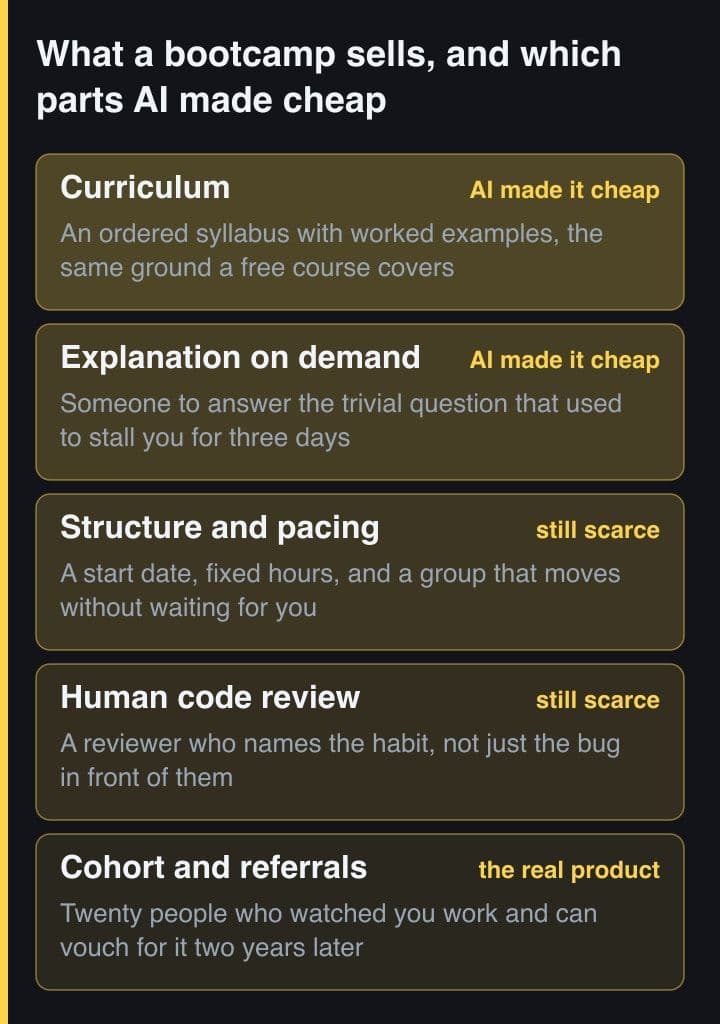
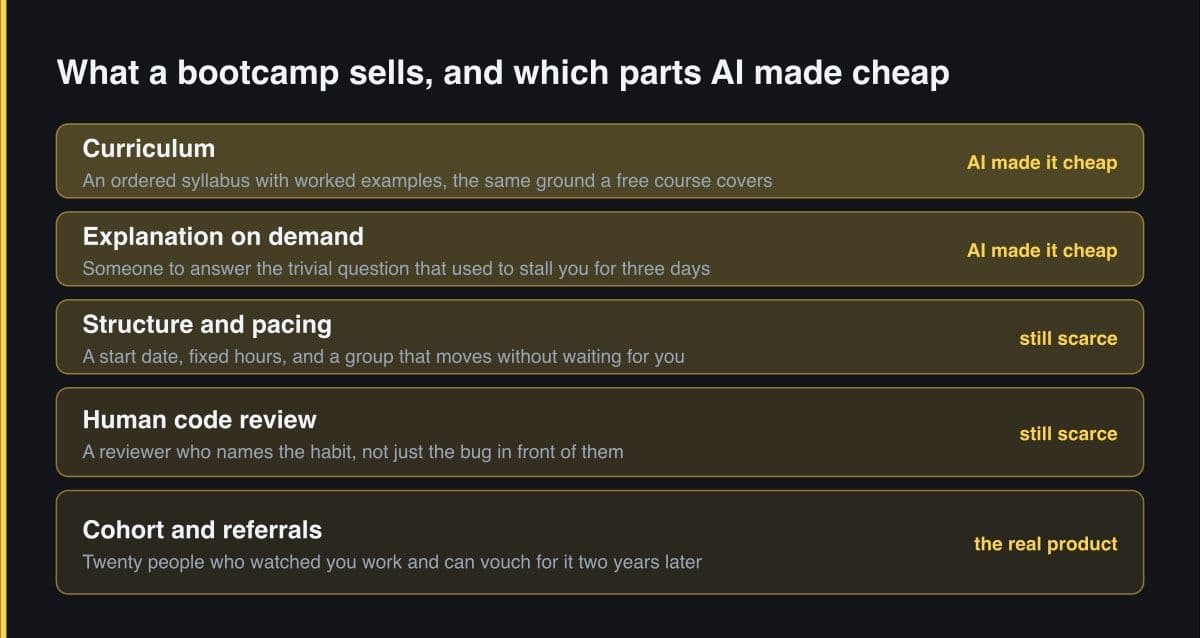
A bootcamp sells five separate things at one price, and they were never equally valuable:
- Curriculum — an ordered syllabus with worked examples and a sensible topic order.
- Explanation on demand — someone to answer the question that has you stuck.
- Structure and pacing — a start date, fixed hours, and a group moving without you.
- Human code review — a reviewer who names the habit rather than only the bug in front of them.
- The cohort — fifteen or twenty people who watched you work, plus the staff who watched all of you.
Unbundling those five is the only way to price the decision honestly in 2026, because exactly two of them have collapsed in cost since 2022, and they happen to be the two that are easiest to put on a landing page.
What AI tooling changed for the self-taught
For the self-taught the change is genuinely large, and it is not that an agent writes the code for you. The historical failure mode of self-teaching was never the syllabus — free syllabuses have been excellent for a decade. It was getting stuck alone at 23:00 on something trivial: a path that will not resolve, a CORS error, a migration that refuses to run. Three days of that with nobody to ask is how most people quit, and it happened to almost everyone who tried.
An always-available explainer removes that specific failure, and the survey data shows the shift. In the 2025 Stack Overflow Developer Survey, 44% of respondents named AI codegen tools or AI-enabled apps among the online resources they learn from, just under videos at 50% and well above blogs and podcasts at 34.8%. On the same page, only 5.2% named a coding bootcamp as a way they learned to code, against 58.7% for other online resources and 32.7% for online courses or certification. That is a global, self-selected sample rather than an Indonesian one, but the ordering is not subtle.
Structure without a fee already exists. The Odin Project publishes a full, ordered full-stack path with projects and a public community, free and open source. If your objection to self-teaching is that you would not know what to learn next, that objection has been solved for years — the one that remains is that nothing happens when you stop.
The failure mode both routes now share
Here is the part neither route's marketing mentions. Both can now produce someone who ships working code and cannot debug it, and debugging is what the job actually tests. A bootcamp graduate who used an agent for every assignment and a self-taught learner who used one for every blocker arrive at the same place: fluent at producing code, unpractised at the loop of forming a hypothesis, testing it, and being wrong.
I have written about that loop in detail elsewhere on this blog, so I will not restate the argument here — only its consequence for this decision. The 2025 survey supports the worry rather than settling it: 66% of respondents cited AI solutions that are almost right but not quite, 45% said debugging AI-generated code takes longer, and 46% distrust AI accuracy against 33% who trust it. Rising adoption alongside falling trust is the honest summary, and neither route protects you from it by itself.
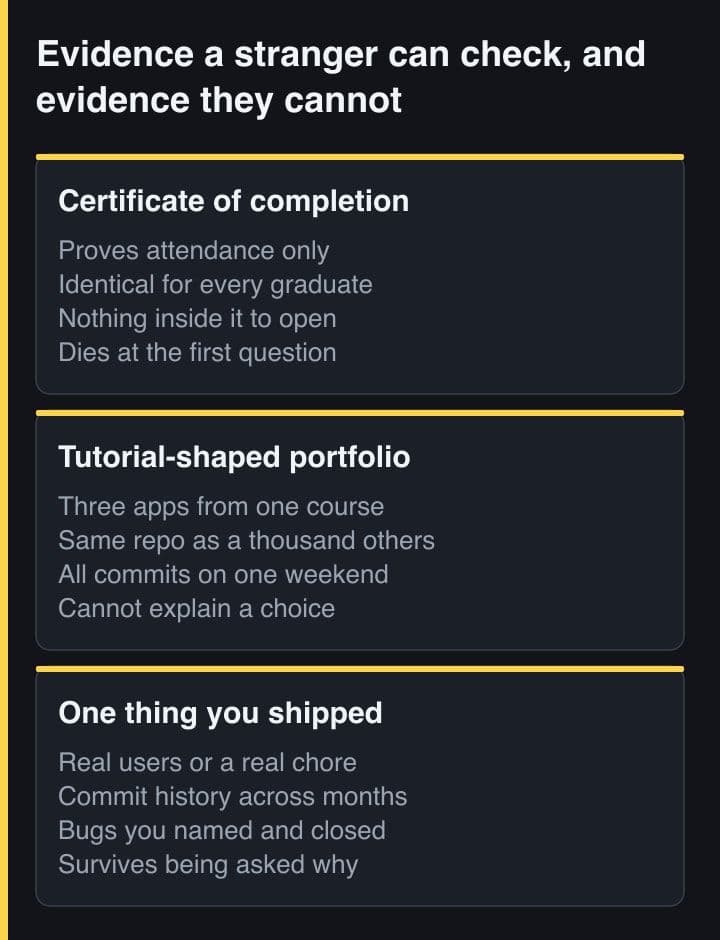
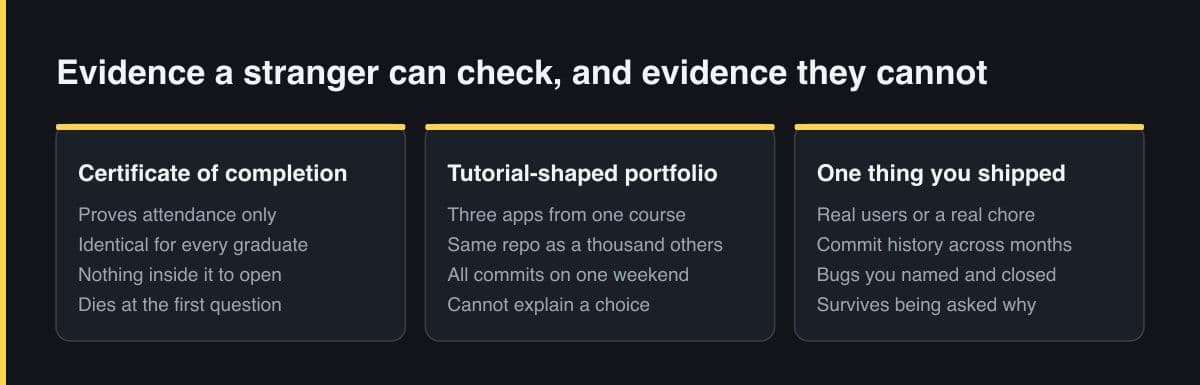
# Whatever route you took, this is the part a reviewer can actually read.
# Run it on the repository you are proudest of, before you send the link.

git log --oneline --no-merges | wc -l
# 8 commits is one weekend. 180 means you kept coming back to it.

git log --format=%ad --date=short | sort -u | wc -l
# Distinct days worked. A tutorial project has three; a real one has forty.

git log -i --grep='fix' --grep='bug' --oneline | head -20
# Every line is a bug you found, named and closed. This is the list you
# get asked about in an interview -- never the feature list in the README.

git log --diff-filter=D --name-only --oneline | head
# What you deleted. Removing your own earlier approach is the clearest
# evidence you had a second idea about it.
The check is cheap, and you can run it on yourself tonight. A tutorial-shaped project and a real one look identical in a screenshot and nothing alike in a Git history, and the history is what a reviewer opens second.
Building the cohort half yourself
If you go self-taught, the honest gap is not knowledge. It is that nothing happens when you stop. A bootcamp charges for structure and a cohort, and both can be assembled by hand — badly at first, and the badly assembled version still beats not having one.
# A cohort you assemble yourself. Four commitments, one page.

MONDAY     Post the week's single goal somewhere public.
           "Ship invoice PDF export" -- not "learn more backend".

WEDNESDAY  Thirty minutes reading someone else's code, out loud.
           Reading badly-named variables is how you learn to name.

FRIDAY     Push something. Broken is fine; absent is not.
           The unbroken streak is the accountability a bootcamp sells.

MONTHLY    Ship one thing to a person who is not you.
           A shop owner, a friend's club, your own recurring chore.
Three things decide whether that page works or fizzles: the weekly goal is a shippable thing rather than a topic, the commitment is public enough to be slightly embarrassing, and at least one person in the group is further along than you. Indonesian developer communities on Discord and Telegram and the local meetups in Jakarta, Bandung and Surabaya are where I would look for the third. The first two are entirely on you.
Read someone else's code out loud once a week, in Indonesian or English, whichever forces you to explain rather than skim. The habit that separates people who can debug from people who can only generate is a willingness to read code you did not write and did not want to read.
What to check before you pay for anything
If you are paying, these are the questions worth asking before the transfer, and every one of them has a checkable answer:
- Is the full syllabus published week by week, before you pay? A course that will not show you what week nine covers is selling a feeling.
- Who teaches, and what have they shipped recently? Ask for a name and a repository, not a job title.
- Does a human read your code, and within how long? This is most of what you are actually buying. If the answer is a peer or an automated grader, you can get that free.
- How large is the cohort, and how many contact hours does it really have? Multiply the two, then divide the fee by the result. That number is the honest unit price.
- What are the deferral and refund terms in writing? Ask what happens if you fall ill in week six, and get the answer in a document rather than a chat message.
- What happens on the last day? An alumni channel still active a year later is worth more than the certificate that comes with it.
Treat every advertised outcome statistic as marketing until someone names the auditor. Schools publish placement and completion figures that nobody outside the school has checked, the denominator is rarely defined, and graduates who stopped replying are usually missing from it. The unverifiability is the point: a number that cannot be audited cannot be compared between schools, so do not choose on it.
None of this is an argument against paying. If you already know that you do not start without a start date, a bootcamp is selling you the one thing you have failed to build three times on your own, and buying it deliberately is a reasonable decision. Just buy it knowing which of the five things you are getting, and which two you could have had for the price of a domain name.
Two years from now nobody will ask which route you took. They will open one thing you built, ask why you chose the database you chose, and listen to whether the answer is yours. Bootcamp or self-taught, the deliverable is identical: one real thing, finished, with a commit history showing you fought for it, and the ability to explain every decision in it without opening a browser tab.
Sources and further reading
- 2025 Stack Overflow Developer Survey — Developers section, learning-to-code methods and online resources
- 2025 Stack Overflow Developer Survey — AI section, trust, daily usage and debugging time
- Hacktiv8 — AI-Enhanced Full Stack Developer Bootcamp, published fee, schedule and batch dates
- Dicoding Help — Berapa Harga Kelas Dicoding, published subscription prices in IDR
- The Odin Project — free, open-source full-stack curriculum with projects and a community