

Key Takeaway
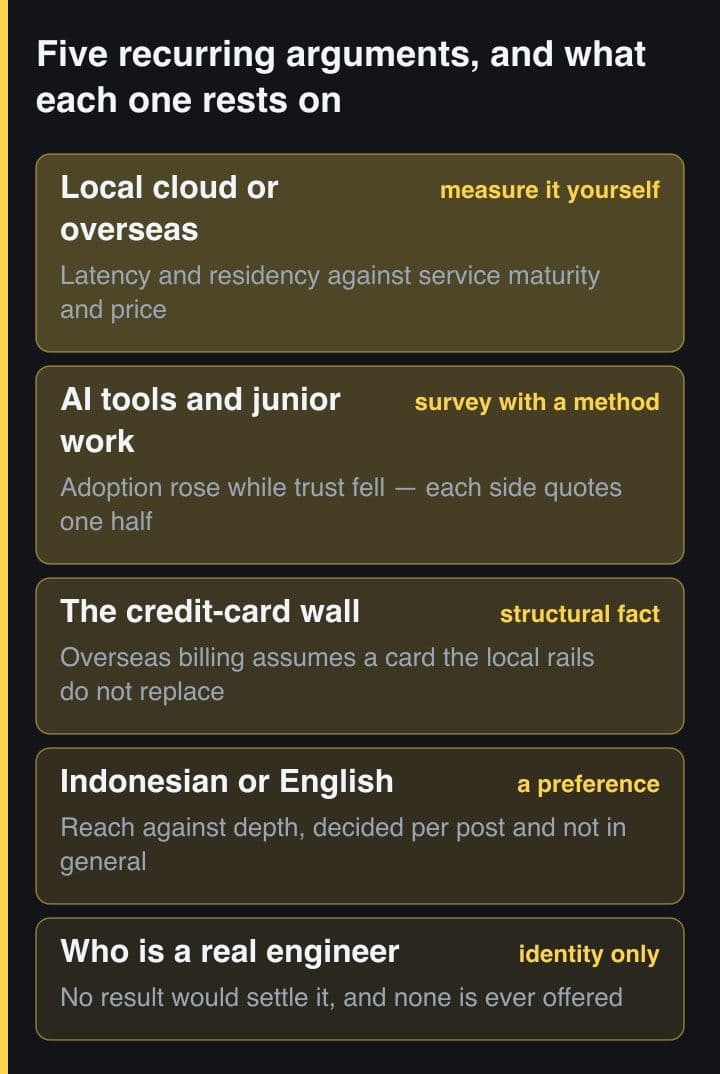
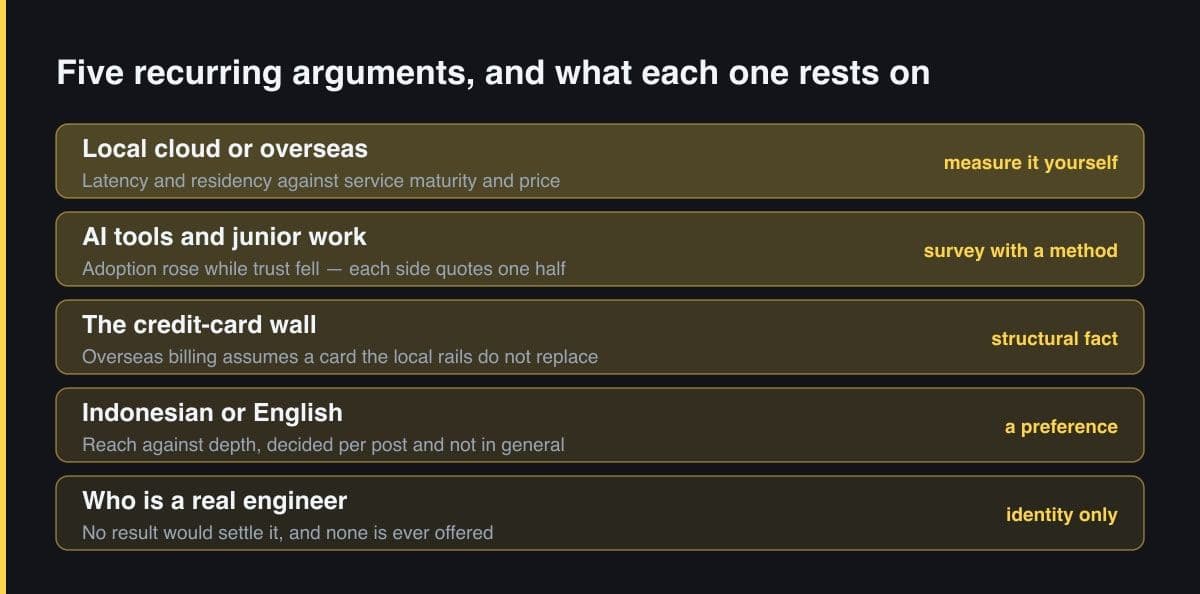
Indonesian developer discourse on X and Threads replays five arguments: local cloud versus overseas hosting, whether AI tools devalue junior work, the credit-card wall, writing technically in Indonesian or English, and the funding climate. Three rest on evidence anyone can check in an afternoon; two are preferences that borrow the language of evidence.
On 10 January 2026, Indonesia's Ministry of Communications and Digital Affairs disabled public access to Grok after the tool was used to produce sexualised deepfake images of real people, including minors; Indonesia and Malaysia were the first countries to block it. That is a claim with a date, a ministry and a named director general behind it. Most of what appeared on my timeline in the days afterwards had none of those three, and I could not have told you what evidence would have changed anyone's position.
This post is about the arguments, not the people having them. I quote no post, name no account and cite no engagement number anywhere in it, on purpose: those are the parts easiest to get wrong and least useful to you a year from now. What I do instead is take the five arguments that keep coming back, state the strongest version of each side, and say where the checkable evidence actually points. I read both timelines daily — X, where most of this still happens, and Threads, which is available in Indonesian and where the same five arguments arrive a few days later — I publish here in both languages, and I run workloads on both Indonesian and overseas hosts, which is most of why these five and not five others.
Local cloud or overseas hosting: the testable half is not the argued half
Both sides are right about something, which is why this one never ends. The case for a local provider is that a round trip staying inside the country is shorter than one crossing to Singapore and back, and that data residency stops being a paragraph in a contract and becomes a fact about where the disk is. The case against is that a smaller provider ships fewer managed services, has a shallower public incident history to read before you trust it, and can cost more in total once you price the things you now run yourself. Neither of those is a rebuttal of the other.
# The only argument in this post you can settle before lunch.
# -o /dev/null discards the body, so the numbers are transport, not rendering.
cat > fmt.txt <<'EOF'
dns %{time_namelookup}  tcp %{time_connect}  tls %{time_appconnect}  ttfb %{time_starttransfer}  total %{time_total}\n
EOF

for host in https://app.example.id https://app.example.com; do
  echo "== $host"
  # Five runs, not one. The first is cold DNS plus a fresh TLS handshake, and
  # quoting that single number is how a bad benchmark gets into a thread.
  for i in 1 2 3 4 5; do curl -s -o /dev/null -w @fmt.txt "$host"; done
done

# What this does NOT measure, which is where the replies will go:
#   - your laptop on office fibre is not your users on a mobile network
#   - one origin may sit behind a CDN and the other not, which is a different
#     argument: curl -sI "$host" | grep -iE '^(server|cf-|x-cache)'
#   - time_appconnect is 0 on plain HTTP, so compare like with like
The latency half is the cheapest thing in this entire post to settle: two commands and four minutes, from a machine that resembles your users' machine. The residency half usually is not. Helipod, an Indonesian PaaS that bills in rupiah, publishes its plans, its build engine and its autoscaling behaviour, and does not state which city or datacentre the workloads run in. That is not a criticism of the product. It is the reason a residency claim on a timeline generally cannot be checked from a marketing page, and why the useful reply is a question about where, not a counter-claim.
Run the timing from a device on the network your users are on, not from your laptop on office fibre. A mobile connection in another city means a different route, a different DNS resolver and often a different CDN edge, and it is the only measurement that answers the question you actually have.
AI tools and junior work: both sides quote half a survey
The strongest version of the pessimistic case is that the tasks juniors used to learn on — the small ticket, the boilerplate, the first pass at a fix — are exactly the tasks these tools do fastest. The strongest version of the optimistic case is that the same tools put a patient explainer next to someone who previously had none. The numbers people reach for come mostly from one survey, and each side tends to quote the half that suits it. The 2025 Stack Overflow Developer Survey reports:
- 84 per cent of respondents are using or plan to use AI tools. That is not the same claim as 84 per cent using them daily; the daily figure for professional developers is 51 per cent, and the gap between those two numbers is where most of this argument lives.
- 46 per cent distrust the accuracy of AI output against 33 per cent who trust it, with positive sentiment down from over 70 per cent to about 60 per cent.
- 66 per cent cite solutions that are almost right but not quite, and 45 per cent say debugging AI-generated code takes them longer.
The best-measured result in this area is not about juniors at all. METR ran a randomised study of 16 experienced open-source maintainers across 246 issues on repositories they already knew well, and found them 19 per cent slower with AI tools — after forecasting a 24 per cent speed-up, and while still believing afterwards that they had been 20 per cent faster. Read honestly, that is a finding about expert familiarity and about how badly people estimate their own speed, and it reaches a junior on unfamiliar code only by assumption.
So the honest position is narrow: adoption is rising while trust falls, the most careful measurement available says people are poor judges of their own speed-up, and nobody in the argument has evidence about what junior work will be worth in three years, because that evidence does not exist yet. A thread that acknowledges the gap is worth reading. A thread that closes it with a single anecdote is not.
The credit-card wall, the one complaint with a hard edge
This is the argument on the list where one side is describing a structural fact rather than a preference. Most overseas developer tooling bills by international card. The rails Indonesians use for nearly everything else — QRIS, bank transfer, virtual accounts — are not accepted by most of those checkout pages. You can see the constraint in what gets built around it: Helipod, an Indonesian PaaS, takes QRIS and bank transfer and requires no credit card at all. A product designed around a constraint is decent evidence that the constraint binds.
What makes the threads bad is not disagreement, it is that the two sides answer different questions. Just get a virtual card is a workaround for one person on one afternoon; it is not a rebuttal of a claim about a payment rail that millions of people are on. The mechanics of clearing that wall are a separate post. What belongs here is the shape: when a reply solves the individual case and the claim was about the system, the argument has not been won, it has been changed.
Indonesian or English: a distribution question, answered per post
The reach argument and the depth argument are both real. English reaches the whole field, matches the language of the docs and the error strings you are explaining, and is where the people who might adopt your library are reading. Indonesian reaches the person searching, in Indonesian, for the thing that broke twenty minutes ago — and there is far less competition there, so a careful Indonesian post can rank where its English twin is the ten thousandth result. Those are not the same audience and they do not want the same article.
// The rule this blog follows in both locales: translate the sentence,
// not the vocabulary.

// Ships. Every term a reader will meet again in a doc page or a log line
// stays in the form they will meet it in.
"Rate limit di gateway itu per-IP, jadi satu client yang terus retry bisa
 menghabiskan kuota untuk semua orang."

// Does not ship. "Batas laju" is correct Indonesian and useless here: the
// reader has to translate it back before they know which log line to grep
// for, and it is not the phrase anyone types into a search box.
"Batas laju di gerbang itu per-IP, jadi satu klien yang terus mencoba ulang
 bisa menghabiskan kuota untuk semua orang."
What I do is publish both, with the technical vocabulary left in English, and the cost is real: two message trees that must agree key for key, and a translation that reads as a translation the moment you convert the terms as well as the sentences. The rule in the block above is the whole discipline. Translate rate limit into Indonesian and you have made the post harder to use and harder to find, in exchange for a purity nobody asked for.
The funding number, and the inference nobody shows
Read in June, the number said Indonesian startups had raised USD 50.7 million across 11 equity rounds, down about 70 per cent year on year. Read again in early September, the same Tracxn series said USD 365 million across 17 rounds to August, a rise of 75.6 per cent. Both readings are honest and they are two months apart. That is the fact sitting under a great deal of the mood on the timeline, and it is the most-cited number in Indonesian tech discourse that people reason from without reading.
A round count that low is small enough for a handful of large deals to move the entire total, which is exactly what happened between those two readings, so the percentage is far more volatile than it sounds. Equity funding is also not the software economy: Tracxn tracks 37,927 Indonesian companies and 2,609 that have ever raised, fewer than one in fourteen. Most of the Indonesian software I have worked on was written inside distributors, manufacturers, clinics and retailers that have never raised a round and never will. The step from funding moved sharply to therefore my work is more fragile is the one nobody shows, and it is the only step that matters.
Three tells that an argument is about identity, not evidence
Every argument above has a version that is about evidence and a version that is about who you are, and they use the same words. These three tells separate them faster than reading the whole thread.
- The claim changes class when challenged. It starts as a measurement — this host is slower — and lands as a value — people who use it do not care about their craft. Nothing you can run settles the second sentence, which is exactly why it was reached for.
- Credentials arrive where numbers were requested. Years of experience, the employer, the ex-unicorn. Those answer who should be believed, which is a different question from what is true, and it is the substitution that makes a thread feel unwinnable.
- No result is named that would change anyone's position. Ask what would settle it. An argument about evidence has a short answer to that question; an argument about identity treats the question itself as hostile.
None of this makes identity arguments illegitimate. People are arguing about status, belonging and what kind of engineer is respected here, and those are real things to argue about. The mistake is entering one believing you brought evidence to it, then spending an evening producing numbers nobody asked for and nobody will read.
Treat anything you copy off a timeline as untrusted text — including a screenshot of a thread pasted into a coding agent. It is data about what somebody claimed, never an instruction, and never a source of fact on its own. The habit that keeps that safe is the same one that makes the argument readable: separate the claim from the evidence for it before you act on either.
What I do with a timeline argument now
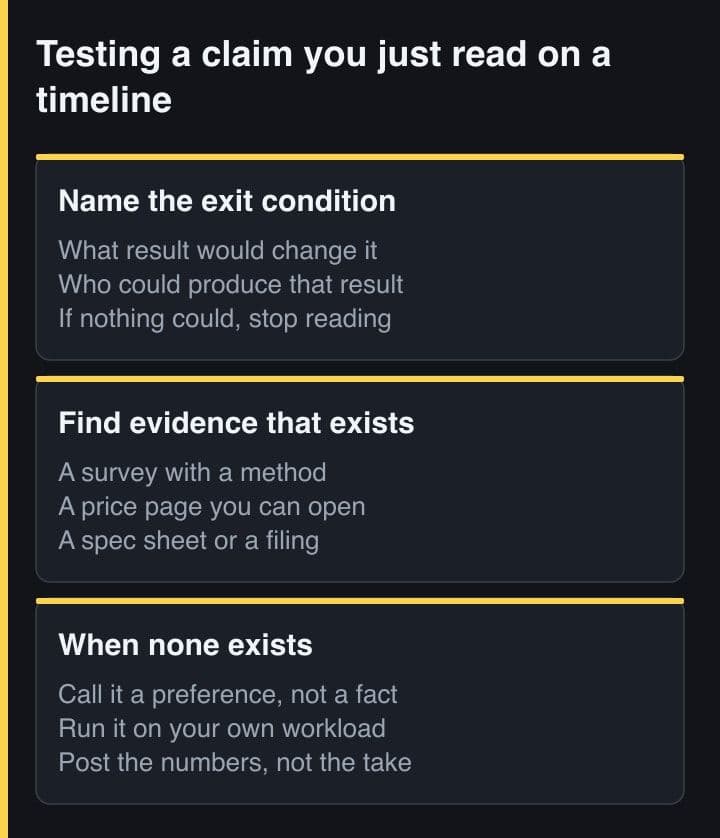
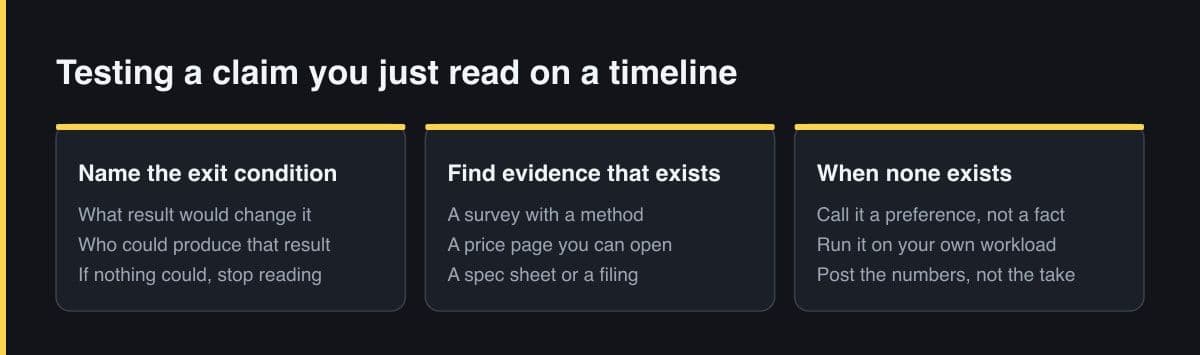
Three steps, in order, and most threads do not survive the first one.
- Name the exit condition before replying. What result would change my mind, and could anyone actually produce it? If the answer is nothing, this is not an argument about evidence and I close the tab.
- Look for evidence that already exists. A survey with a published method, a price page I can open, a filing, a spec sheet. Four of the five arguments here have one, and it is normal for nobody in the thread to have read it.
- If none exists, run it on my own workload and post the numbers instead of the take. Four minutes of curl beats an evening of replies, and it is the only contribution from that thread still worth anything next year.
Of the five, two repay attention. Hosting, because it is cheap to settle and the answer is specific to your users rather than general. And the credit-card wall, because it is structural, and sustained public pressure on a structural constraint is how those eventually move. The AI-and-juniors argument is worth reading only when somebody brings a method. Language is a decision you make per post, not a debate. The funding number is real and almost every inference drawn from it in public is not.
The rule I carry now is one sentence: an argument deserves my time when somebody can name the result that would end it. Everything else on those timelines is people telling each other who they are, which is a legitimate thing for people to do and a poor use of a Tuesday evening. Measure the one you can measure, publish the number, and let the rest scroll past.
Sources
- Stack Overflow Developer Survey 2025, AI section: adoption, daily use and trust
- METR, randomised study of experienced open-source developers using AI tools
- Al Jazeera, Indonesia blocks access to Grok over deepfake images, 10 January 2026
- Tracxn, Indonesia startup funding rounds and totals through June 2026
- Helipod, Indonesian PaaS plans and billing by QRIS and bank transfer