
Product
Warung Inventory Micro-SaaS: Offline-First for Indonesia
April 20268 min read

It is a small subscription app that helps Indonesian warung and small shops track stok barang instead of a notebook or Excel. It is built offline-first so it works on a low-end phone without a reliable signal, and priced low, roughly tens of thousands of rupiah per month, for mass adoption rather than a few large clients.
Connectivity inside Indonesian shops is often weak, and mobile data is a cost owners watch closely. An offline-first app treats the phone as the source of truth and the network as optional, so every sale and restock is recorded instantly and syncs later. That means the app never fails at the exact moment a customer is buying.
Every change is appended to an outbox queue as an ordered, immutable event rather than overwriting rows. A background process drains that queue whenever the network returns, retrying with backoff. Because stock changes are stored as additive deltas, delayed or out-of-order sync still adds up correctly instead of corrupting counts.
Send a plain WhatsApp message when an item crosses its reorder point, instead of expecting the owner to open a dashboard. Warung owners already live in WhatsApp, so reaching them there gets alerts read and acted on. The message should simply name the item and suggest reordering.
Over-building and pricing too high. Shipping accounting, tax, and multi-user roles before owners reliably log daily stock kills momentum and inflates infrastructure cost. Charging like a Western SaaS also ignores that mass adoption at a very low monthly price is the entire business model for this market.
Key Takeaway
A warung inventory micro-SaaS is a tiny subscription app that lets small Indonesian shops track stok barang on a low-end phone that works even without signal. It stays cheap by keeping data on the device, queuing every change in an outbox, and syncing to a server only when connectivity returns.
The warung is the backbone of Indonesia's informal retail economy: family-run shops selling snacks, drinks, cigarettes, and daily necessities on nearly every street. Most of them still track stock in a paper notebook or, at best, a messy Excel sheet that only the owner understands.
That is a real, painful, repeatable workflow, which is exactly what a micro-SaaS should target. This post is an architectural blueprint for a stok barang app built for spotty connectivity, low-end Android, and non-technical owners, priced low enough for mass adoption rather than a handful of big clients.
A typical warung owner does not know precisely how much stock they have or which items are running out until a shelf is empty and a customer walks away. Reordering is done from memory, so fast movers vanish while slow movers pile up and tie down cash. Inventory management software exists to record, track, and manage stock levels so shortages and overstocking both shrink, but enterprise tools are far too heavy and expensive for a shop of this size.
The owner is not a bookkeeper and does not want to become one. Any app that demands ten taps to record a sale, forces a stable connection, or drowns them in menus will be abandoned within a week. The winning product removes friction, not adds features.
Connectivity across Indonesia is uneven and often unreliable inside a concrete shop, and mobile data is a real cost the owner watches closely. An app that only works when the signal is strong is an app that fails at the exact moment a sale happens. Offline-first flips the default: the phone is the source of truth for the current session, and the network is treated as an occasional convenience, not a requirement.
This is the same principle behind offline-first web and mobile stacks, where data is stored locally and synchronized with a server only when the device is back online. The owner records sales and restocks instantly, sees an instant response, and never stares at a spinner. Sync happens quietly in the background whenever a connection appears.
Design every screen to be fully usable with the airplane mode turned on during development. If a feature breaks offline, it is not ready to ship to a warung.
The design rests on four moving parts. A local store holds all inventory and transactions on the device so reads and writes are instant. An outbox queue captures every change as an ordered log to be replayed to the server later. A conflict resolution rule decides what happens when the same item was edited in two places, and a background sync process drains the outbox whenever the network returns.
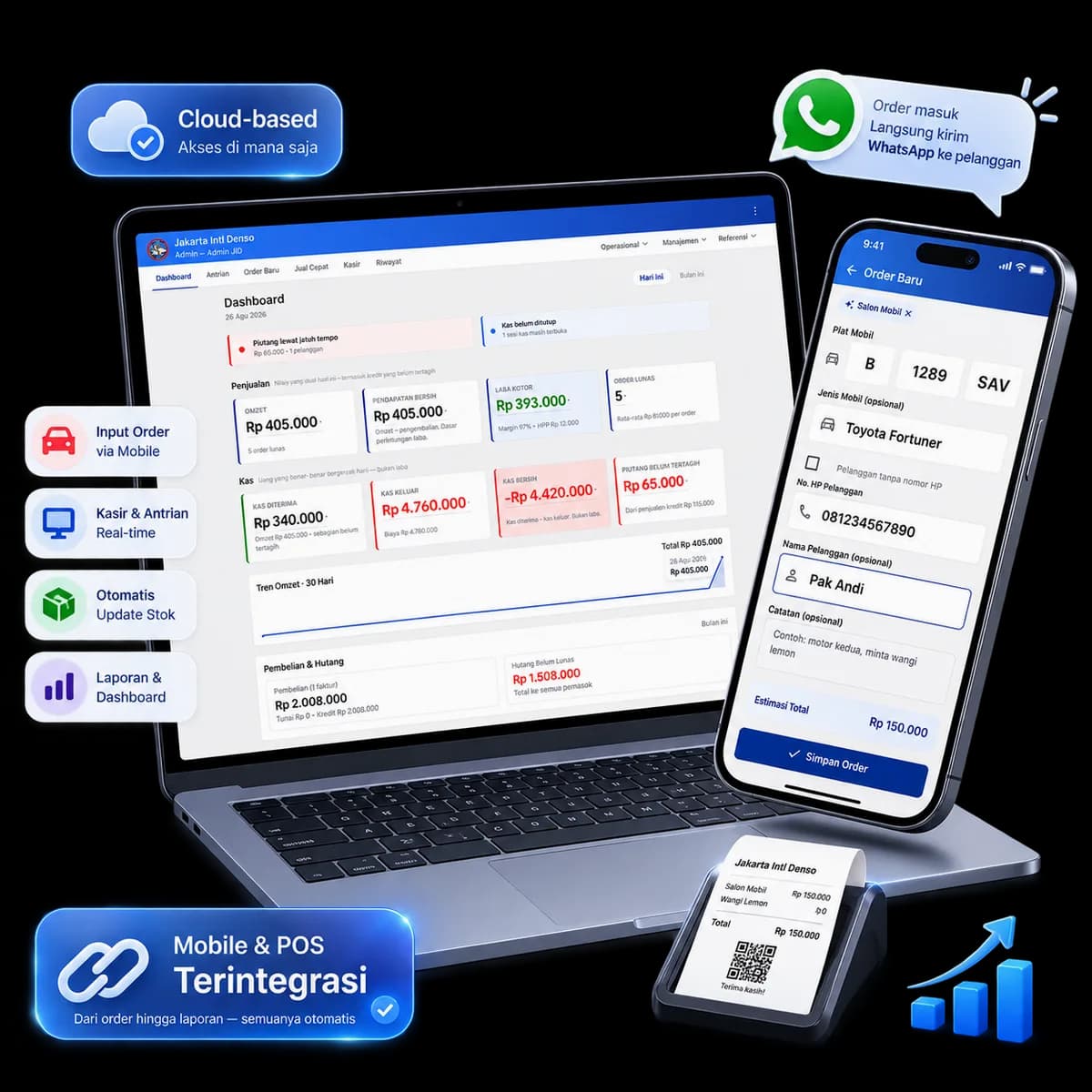
Ship the smallest thing that replaces the notebook. Quick add lets the owner log a sale or restock in one or two taps from a big-button home screen. A barcode scan using the phone camera turns a slow lookup into an instant one, matching how modern inventory tools identify products. Low-stock alerts push a plain WhatsApp message when an item crosses its reorder point, meeting the owner where they already are instead of forcing them into a dashboard.
Reports stay deliberately simple: today's sales, this week's best and worst sellers, and a list of what to reorder. That is enough to change behavior. Everything else, from multi-branch support to supplier integrations, is a distraction until the core loop is loved.
Do not build barcode scanning as the primary entry path first. Many warung items have damaged or missing barcodes, so quick manual add must always be the fast default and scanning an accelerator.
Most builders lose here, not in the code. The three classic mistakes are over-building, mishandling sync conflicts, and pricing for enterprises instead of warungs. Founderplus, writing on Indonesian micro-SaaS niches, argues success comes from extreme specificity and affordability rather than technical sophistication, with real adoption at monthly prices measured in tens of thousands of rupiah.
A warung inventory micro-SaaS wins by being boring, instant, and cheap rather than clever. Nail the offline-first core loop, keep infrastructure lean so low prices still profit, and reach owners through WhatsApp instead of dashboards. Do that for one narrow segment and the 65 million Indonesian SMEs behind it become a genuine market.