

Key Takeaway
On 24 November 2026, Anthropic announced four MCP features for Claude. As of 27 November 2026, Skills over MCP is in public beta in Claude and Claude Code, though its protocol extension is Final; Tasks and Elicitation are generally available on Pro, Max and Ultra plans; and File Uploads, an experimental extension, is rolling out soon.
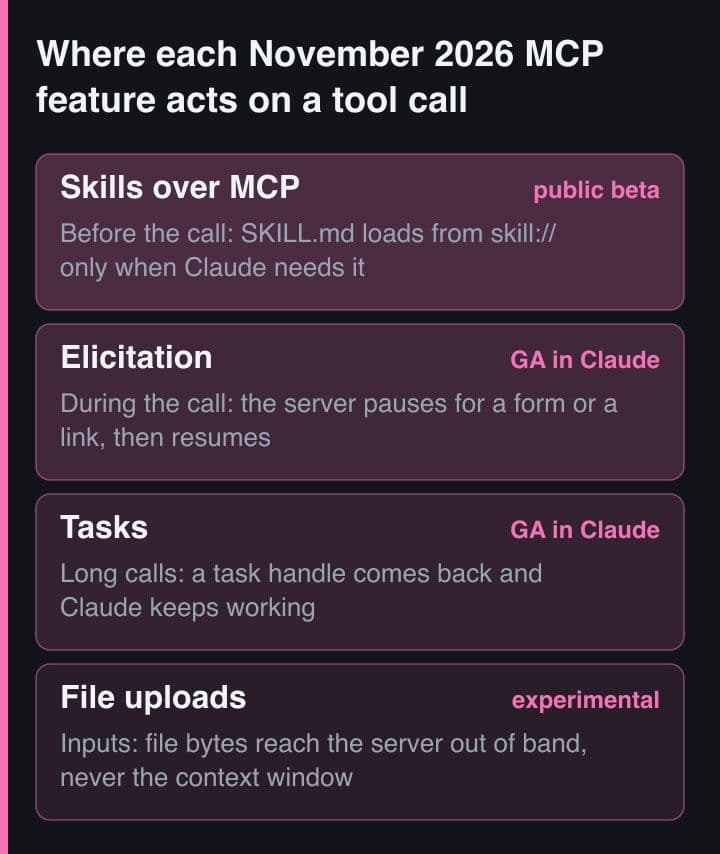
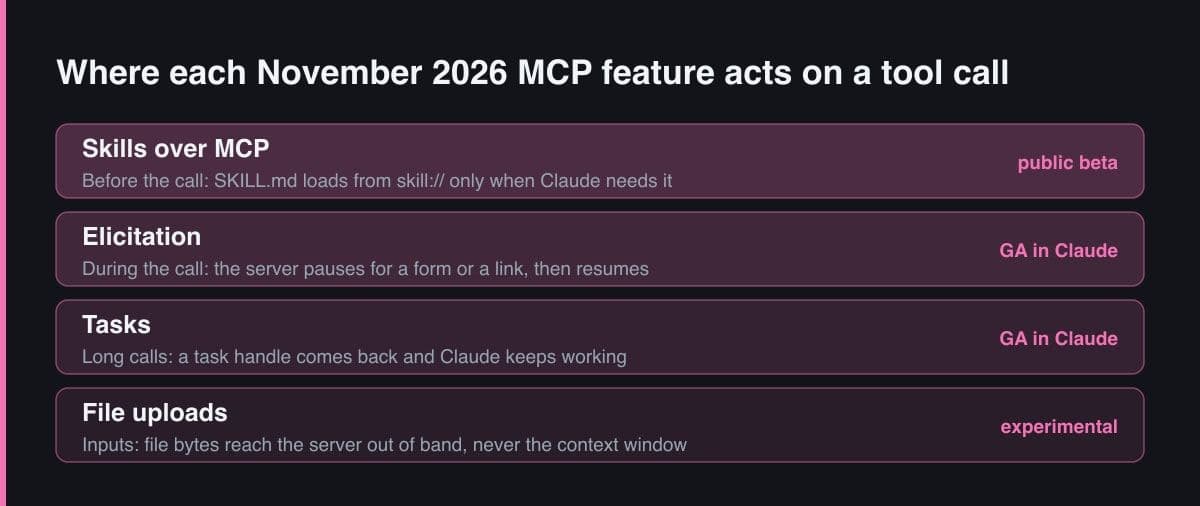
On 24 November 2026, a day before the Model Context Protocol's second birthday, Anthropic announced four MCP features for Claude and Claude Code. Skills over MCP lets a server publish skills next to its tools, and it is in public beta. Tasks lets a server run long work in the background, and Elicitation lets it stop and ask the user for input; both are generally available on Pro, Max and Ultra plans and rolling out to Team and Enterprise. File Uploads, which hands PDFs, spreadsheets and images to a server without passing them through the context window, is rolling out soon. [1, 2]
Every status in this post was checked against its primary source on 27 November 2026: the announcement, the MCP project's anniversary post, the Skills and Tasks extension proposals, the 2026-07-28 elicitation spec, the file-uploads draft and the Claude Code MCP docs. All four features sit on the stateless core that the 2026-07-28 revision introduced, which I covered in the MCP 2026-07-28 spec migration guide, so this post does not explain it again.
Statuses checked against the linked sources on 27 November 2026. Beta and rollout labels change quickly, so check the source before you plan around one.
What shipped on 24 November 2026?
Each feature carries two labels worth keeping apart: the status of the protocol text, which the MCP project sets, and the status of the feature in Claude, which Anthropic sets. The table holds both, as of 27 November 2026. [1, 3, 4, 5, 8, 10]
| Feature | What it does | Protocol status | Status in Claude | Minimum Claude Code version | What it replaces |
|---|---|---|---|---|---|
| Skills over MCP | The server publishes Agent Skills, folders with a SKILL.md, next to its tools. Claude loads one only when it needs it. | Final extension: SEP-2640, io.modelcontextprotocol/skills | Public beta in Claude and Claude Code. On by default for Pro, Max and Ultra, for Team once an admin enables it, coming soon to Enterprise | v2.1.331 | Companion skills installed separately from the server, and server instructions too long for their field |
| Tasks | The server answers a tool call with a task handle and keeps working. The client polls until the result is ready. | Final extension: SEP-2663, io.modelcontextprotocol/tasks | Generally available for Pro, Max and Ultra, rolling out to Team and Enterprise | v2.1.304 in the terminal, v2.1.331 in VS Code and the Desktop app | The experimental core tasks of the 2025-11-25 spec, and tool calls that had to finish before Claude could move on |
| Elicitation | The server pauses a call to ask the user through a form, or sends them to a URL for anything sensitive. | Core spec feature. In 2026-07-28 it travels as a Multi Round-Trip Request; URL mode dates from 2025-11-25 | Generally available for Pro, Max and Ultra, rolling out to Team and Enterprise | No single floor in the docs | Hoping the model asks before a costly or destructive call: the server now asks itself |
| File Uploads | The client uploads file bytes out of band and retries the call. The bytes never enter the context window. | Experimental extension, not a SEP. Breaking changes expected | Rolling out soon to Pro, Max, Ultra and eligible Team and Enterprise plans | Not published | Pushing file contents through the context window |
The same announcement gives the scale behind it: over 700 million monthly SDK downloads, over 10,000 MCP connectors for Claude, and tool search that can cut the context tool definitions use by over 85% in multi-server setups. The MCP blog post from lead maintainers David Soria Parra and Den Delimarsky, published the same day, counts more than 2,500 unique contributors and 5 billion total SDK downloads, more than 4.5 billion of them in the past year. It adds that Events reached beta earlier in November and that the next spec release is planned for March 2027. [1, 2]
What is Skills over MCP?
Skills over MCP lets a server ship the know-how for its tools as Agent Skills. A tool description says what one tool does; a skill says how to combine tools for a job, step by step. A skill is an Agent Skills directory with a SKILL.md whose YAML frontmatter holds at least a name and a description. The server exposes every file in it as an MCP resource, conventionally under skill:// followed by the skill path and the file path, and the last segment of the skill path must equal the name. Because the skill lives on the server, it updates when the server does, and users have nothing separate to install. [3, 1]
# Illustrative skill served over MCP (SEP-2640). Every file is a resource.
skill://invoice-export/SKILL.md                  # required; last path segment == name
skill://invoice-export/references/FIELDS.md      # fetched only when the skill points to it
skill://invoice-export/scripts/check_totals.py

# --- skill://invoice-export/SKILL.md ---
---
name: invoice-export
description: Export posted invoices to CSV with export_invoices. Use when the user asks for an invoice export or a month-end extract.
---
# Invoice export
1. Call list_periods and confirm the period with the user.
2. Call export_invoices with status "posted". Drafts are not final figures.
3. Compare the row count with references/FIELDS.md before handing the file over.

# --- server/discover: the skills extension also needs the resources capability ---
{ "capabilities": {
    "resources": {},
    "extensions": { "io.modelcontextprotocol/skills": { "directoryRead": true } } } }

# --- one skills/list entry (trimmed). The manifest lists EVERY file. ---
{ "uri": "skill://invoice-export/SKILL.md",
  "frontmatter": { "name": "invoice-export", "description": "Export posted invoices ..." },
  "resources": [
    { "uri": "skill://invoice-export/SKILL.md", "digest": "sha256:9f2c...", "size": 1840 },
    { "uri": "skill://invoice-export/references/FIELDS.md", "digest": "sha256:41ab...", "size": 2210 },
    { "uri": "skill://invoice-export/scripts/check_totals.py", "digest": "sha256:c07e...", "size": 960 } ] }
# Change any file and the digest set changes, so the host revokes the old approval.
SEP-2640 adds little new surface and a lot of host rules. A server that declares io.modelcontextprotocol/skills must also declare the resources capability and must implement skills/list and skills/get; resources/directory/read is optional. Each skills/list entry carries the URI, the frontmatter and a manifest of every file with its sha256 digest and size. Hosts must not fetch skill files ahead of need, must treat skill content as untrusted input, and must not treat a resource as a skill just because of its URI scheme. When the manifest changes, any stored approval for that skill is revoked. Servers should keep each skill within 512 files and 16 MiB. [3]
In Claude Code a server's skill appears in the slash menu as the server name, a colon and the skill name, such as docs:pdf for a pdf skill on a server named docs; connector skills carry a prefix, such as claude_ai_Docs:pdf. You also need a supported model and a direct connection to Anthropic, and claude -p runs, cloud sessions, GitHub Actions, the Agent SDK and a custom ANTHROPIC_BASE_URL get no MCP skills. Writing the SKILL.md itself is the same craft as writing a local skill, which I cover in my Claude Code skills authoring guide. [10]
How do MCP Tasks work?
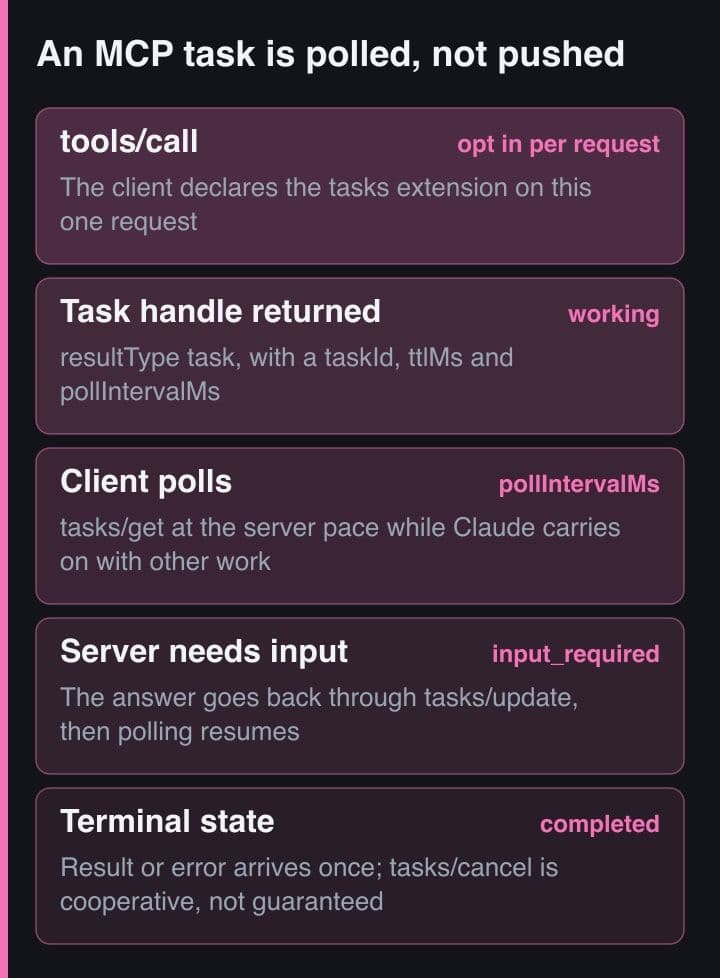
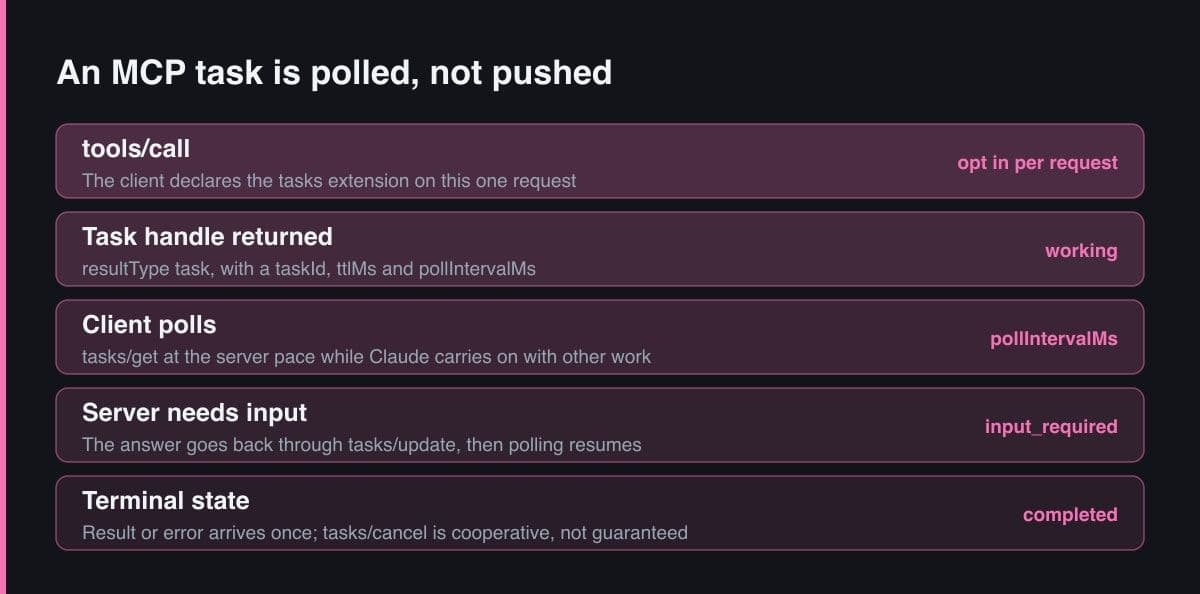
MCP Tasks turn a slow tool call into a handle. The client declares the tasks extension in the capabilities it sends with each tools/call, and the server decides, for that request alone, whether to answer with the normal result or with a CreateTaskResult: resultType task, a taskId, a status, timestamps, ttlMs and an optional pollIntervalMs. A server must not return a task to a request that did not declare the extension. Anthropic's launch example is ZoomInfo, which now runs account and contact research that previously took several prompts. [4, 1]
// Illustrative, following SEP-2663 and the example in Claude Code's MCP docs.

// 1. Client -> server: an ordinary tools/call. Declaring the extension in the
//    per-request capabilities is the only opt-in. Without it, no task.
{ "method": "tools/call",
  "params": {
    "name": "run_aging_report",
    "arguments": { "period": "2026-11" },
    "_meta": { "io.modelcontextprotocol/clientCapabilities": {
      "extensions": { "io.modelcontextprotocol/tasks": {} } } } } }

// 2. Server -> client: a CreateTaskResult instead of the tool result.
//    Send it only once tasks/get for this taskId would already resolve.
{ "resultType": "task",
  "taskId": "aging-7f3a9c2e",
  "status": "working",
  "statusMessage": "Reading open items",
  "createdAt": "2026-11-27T02:00:00Z",
  "lastUpdatedAt": "2026-11-27T02:00:00Z",
  "ttlMs": 5400000,          // a 30-minute job plus 1 hour to keep the result
  "pollIntervalMs": 10000 }  // jobs over a minute: 10000 to 30000

// 3. Client polls at pollIntervalMs. Nothing is pushed unless the client
//    subscribed to notifications/tasks through subscriptions/listen.
{ "method": "tasks/get", "params": { "taskId": "aging-7f3a9c2e" } }

// 4. Done: resultType "complete", status "completed", and the normal
//    tools/call result (content, isError) inside "result".

// Wrong: answering with resultType "task" when step 1 lacked the extension.
// Claude Code fails the call: Unsupported result type 'task' for tools/call
A task is always in one of five states:
- working: the server is still on it, so the client keeps polling.
- input_required: the server needs an answer. Its questions sit in inputRequests, and the client replies with tasks/update carrying inputResponses.
- completed: the result is in the tasks/get response.
- failed: the work hit a JSON-RPC error, which the task carries in its error field.
- cancelled: the task stopped. Cancelling through tasks/cancel is cooperative, so the server acknowledges it and decides whether and when to stop.
Tasks are pull, not push. The client asks with tasks/get and should respect pollIntervalMs; a server may also push notifications/tasks, but only to a client that subscribed through subscriptions/listen. The redesign dropped the blocking tasks/result and the tasks/list of the 2025-11-25 experiment, and the 2026-07-28 revision moved tasks out of the core protocol into this extension. [4, 6]
In Claude Code, Claude keeps working while a task runs, the footer shows a count, and /tasks lets you answer a task's question or stop it. Outside cloud sessions, Claude Code polls at the server's interval clamped between 250 and 30,000 ms, and uses 2,000 ms when none is sent; it does not use notifications/tasks. A one-shot claude -p run gets no tasks at all. The docs also ask server authors to keep a finished result for at least an hour, because a user can exit and resume the session later. [10]
What is MCP Elicitation, and when should a server use form or URL mode?
Elicitation lets a server stop mid-call and ask the user. Form mode collects structured answers against a flat JSON schema of strings, numbers, booleans and enums. URL mode, added in the 2025-11-25 revision, sends the user to a link for anything that must not pass through the client, such as a sign-in or a payment. The user can accept, decline or cancel, and the server has to handle all three. In the 2026-07-28 revision the question travels as a Multi Round-Trip Request: the server returns an InputRequiredResult, and the client retries the original call with the answers in inputResponses. [5]
The launch examples all guard money or data. Supabase confirms costs before creating a paid project and before running destructive SQL, Railway asks before removing a service, and GitHub has users type a repository's name before an agent deletes it. The typed name is the pattern worth copying, because it is harder to approve on autopilot than a yes button. [1]
// Illustrative MRTR elicitation (spec 2026-07-28): typed confirmation before a delete.

// 1. Server -> client, answering tools/call delete_repository:
{ "resultType": "input_required",
  "inputRequests": {
    "confirm_delete": {
      "method": "elicitation/create",
      "params": {
        "mode": "form",
        "message": "This deletes acme/old-site and its history. Type the repository name to confirm.",
        "requestedSchema": {
          "type": "object",
          "properties": { "repository": { "type": "string" } },
          "required": ["repository"] } } } },
  "requestState": "hmac-signed-opaque-value" }

// 2. Client retries the same tools/call, echoing requestState unchanged and adding:
"inputResponses": {
  "confirm_delete": { "action": "accept", "content": { "repository": "acme/old-site" } } }
// "decline" and "cancel" typically carry no content.
// Delete only on "accept" AND an exact name match, never on accept alone.

// Wrong: a secret in form mode. The spec says servers MUST NOT do this.
//   "properties": { "api_key": { "type": "string" } }
// Right: URL mode, to a page you host. The key never passes through the client.
{ "method": "elicitation/create",
  "params": {
    "mode": "url",
    "url": "https://mcp.example.com/ui/set_api_key",
    "message": "Connect your billing account to continue." } }
Never ask for a secret in form mode. The 2026-07-28 spec says servers MUST NOT use form mode to request sensitive information such as passwords, API keys, access tokens or payment credentials, and MUST use URL mode for those interactions. A name, an email address or a username is not categorically banned, but anything that grants access or authorises a payment goes through a URL the user opens. [5]
Claude Code declares both modes on 2026-07-28 connections. On older protocol revisions it declares both for the servers in your own MCP configuration from v2.1.287, and form mode only for claude.ai connectors. An Elicitation hook can answer requests without a dialog if you run unattended. For the rest of a server's attack surface, from token audience to SSRF, see my MCP server security checklist. [10]
What are MCP File Uploads, and can you build on them yet?
MCP File Uploads moves files between a client and a tool out of band, so the bytes stay out of model context and out of JSON-RPC messages. The server marks file arguments in the tool's input schema. When a call arrives without the bytes, the server rejects it or asks for an upload; the client uploads the file and retries with unchanged arguments. A tool returns a file by listing a download target in the result's _meta. [8]
Its status is the weakest of the four. The repository calls it an experimental extension that is not part of the MCP specification and has not been proposed as a SEP, and it warns to expect breaking changes. The MCP blog says a working group is still prototyping it and wants feedback before it reaches beta. On Anthropic's side, the announcement says File Uploads is rolling out soon, and Claude's connector docs describe file transfers as a beta built on the experimental extension io.modelcontextprotocol/files. [8, 2, 1, 9]
If you build a connector for it, read Claude's requirements before you write code. A file argument is marked with x-mcp-file, the server must speak revision 2026-07-28 over Streamable HTTP, the connector must be listed in the Connectors Directory, and Anthropic must approve the hosts that store the files. The same page notes that version 1.32.2 of the @modelcontextprotocol/sdk package supports neither uploads nor downloads. [9]
Is this MCP 2.0? What coverage gets wrong
No. Some launch coverage framed the update as a new major version; the description of Chase AI's video The BIGGEST MCP Upgrade In 2 Years Just Dropped calls it basically MCP 2.0. The features are real, but five points are easy to get wrong, and they are worth stating plainly:
- There is no MCP 2.0. The specification is versioned by date in YYYY-MM-DD form: 2024-11-05, 2025-03-26, 2025-06-18, 2025-11-25 and the current 2026-07-28. These four features arrived as protocol extensions or as Claude support, not as a new revision. [7, 6]
- Skills over MCP is public beta in Claude, not generally available. Its protocol extension, SEP-2640, is Final: Final describes the spec text, beta describes Claude's support. Tasks and Elicitation are the two that are generally available. [1, 3]
- Tasks are polled. The server hands back a handle and the client calls tasks/get at the pollIntervalMs the server suggests. Push through notifications/tasks is optional, and Claude Code does not use it. [4, 10]
- The Claude Code minimum for MCP skills is v2.1.331, with a dot before 331, not 2.1331. [10]
- File Uploads is an experimental extension that has not been proposed as a SEP, so its shape can still change. [8]
Extensions are how MCP now grows between spec revisions. MCP Apps became the first official extension, Enterprise-Managed Authorization is now a stable one, and Skills and Tasks are Final as SEP-2640 and SEP-2663. A client opts in to each extension through its capabilities, so a server can support one without the others. If the protocol itself is new to you, start with my MCP explainer. [2, 3, 4]
What should you do this week?
If you use Claude Code:
- Update to v2.1.331 or later, type / and look for entries named after your servers, such as docs:pdf.
- Delete local skills you wrote only to teach Claude a server that now ships its own. Two copies of the same guidance drift apart, and the server's copy updates with its tools.
- Decide how MCP skills get approved. In Manual mode you approve each skill version, and a permission rule such as deny Skill(mcp__docs__*) blocks one server's skills. Add only servers you trust, because a skill can direct Claude to run code.
- Run long server jobs in an interactive session. A one-shot claude -p run gets no MCP tasks and no MCP skills.
Check your version before you look for server skills: claude --version prints it and claude update installs the latest. In the Desktop app, read the Claude Code version on the Code tab instead. MCP skills also need a supported model and a direct connection to Anthropic, so an old version is not the only reason they can be missing. [11, 10]
If you maintain an MCP server:
- Ship one skill next to your tools, for the workflow users most often get wrong. Declare io.modelcontextprotocol/skills and the resources capability, and serve skills/list and skills/get.
- Keep each skill within 512 files and 16 MiB. Claude scans skills from some connectors, and a scanned skill is limited to 100 KB per text file and 400 KB per skill; Claude Code also shows at most 100 skills per server.
- Mark long tools for tasks. Return a CreateTaskResult only when the request declares the extension and only once tasks/get for that taskId resolves, and keep finished results for at least an hour.
- Put elicitation in front of every destructive or costly tool, and bind the confirmation to the exact object, such as the repository or project name.
- Never ask for a password, API key, access token or card number in form mode. Use URL mode.
- Keep file uploads behind a flag until the extension settles, and test against Claude's connector requirements, not the README alone.
If you are starting a server from scratch, my TypeScript MCP server guide takes you from scaffold to production with the official SDK. For rolling servers out across a team, the Claude Code MCP setup and governance guide covers scopes, transports, tool search and trust. [3, 4, 9, 10]
Read every MCP status as two labels: what the protocol says and what a client ships. As of 27 November 2026, Skills over MCP is Final in the spec and beta in Claude, Tasks are Final and generally available, Elicitation is core and generally available, and File Uploads is experimental and coming soon. Build against the spec, and plan your rollout against the client.
Sources
- Anthropic: MCP servers can now ship skills, run tasks, and more with Claude (24 November 2026)
- MCP Blog: Two Years of MCP Builders, by David Soria Parra and Den Delimarsky (24 November 2026)
- SEP-2640: Skills Extension (status Final)
- SEP-2663: Tasks Extension (status Final)
- MCP specification 2026-07-28: Elicitation
- MCP specification 2026-07-28: Key Changes
- MCP specification: Versioning
- GitHub: modelcontextprotocol/experimental-ext-file-uploads
- Claude docs: Support file uploads and downloads
- Claude Code docs: Connect Claude Code to tools via MCP
- Claude Code docs: CLI reference